AI is rapidly changing the very foundations of hospitality. In a traditionally labor-intensive industry, AI tools significantly reduce human hours by automating repetitive tasks and streamlining operations.
Different property types will be affected by AI in distinct ways. Among other factors, the service level and staffing model of the hotel impact which solutions are the most suitable and create a return on investment.
This article explores AI by hotel segment, examining which solutions are best suited for limited-service and full-service hotels to pinpoint where the technology delivers the most value for each.
Furthermore, we identify possible barriers to adoption and the most important consideration for building a segment-aligned AI strategy.
AI by Hotel Segment: The Best AI Strategies for Each Hotel Type
AI could contribute up to $15.7 trillion to the global economy by 2030. The hotel sector is expected to especially benefit from this shift, as AI can address many of the industry's structural issues, such as margin pressures and labor shortages.
The benefits of AI on hotel operations are not reserved for large chains. Because automation can take many forms, from simple monitoring systems to elaborate guest-facing apps, properties of all scales and sizes can gain significantly from AI solutions.
However, what works for a limited-service budget hotel may not suit a five-star resort, and vice versa. This is why it is essential to tailor strategies for different service-level segments.
AI Strategies for Limited-Service Hotels
Lean operating models and minimal amenities characterize limited-service hotels. These hotels are often in the economy, midscale, or upper midscale class.
Hotels offering only a few or select services have fewer revenue streams, meaning revenue generation is mainly constrained to rooms. Furthermore, prices are often lower, which makes managing costs essential for maintaining healthy profit margins.
For limited-service hotels, AI pays off the fastest when it creates cost savings and improves efficiency.
Top 3 AI Strategies for Limited-Service Hotels
- AI-driven revenue management (RM) systems – AI-driven revenue management systems can adjust room rates in real time based on predictive analytics, competitor prices, and demand indicators. As many limited-service hotels compete aggressively with price, even minor rate optimizations can be meaningful for overall profitability.
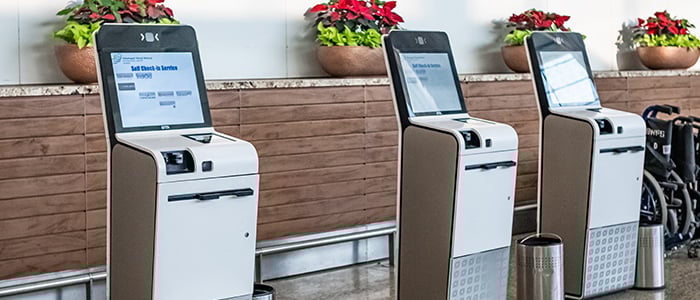
- AI-powered chatbots and automated front desks – Chatbots are valuable tools for automating customer interaction before and during the stay, as they can handle guest queries and even be implemented into self-service check-in kiosks. The front desk experience is one obvious subject of automation, as nearly 80% of travelers would stay at a hotel with a completely automated front desk and are more likely to purchase an upsell when doing so.
- Energy management systems (EMS) – Energy management systems monitor and control energy usage in real-time. Smart heating, ventilation, and air conditioning (HVAC) systems and lighting controls effectively cut out any utility inefficiencies. These solutions can do wonders for the margins of limited-service hotels.
While a hotel from any segment could benefit from these solutions, these tools can be especially fitting for leaner operations or for properties looking to start with AI essentials: the return on investment can be shown quickly when staff hours usually spent on repetitive tasks are saved, and when both pricing and the use of utilities are optimized.
AI Strategies for Full-Service Hotels
Full-service hotels operate with more moving parts and higher guest expectations. Therefore, the role of AI expands from removing friction in operations to adding to the guest experience.
With a wider range of amenities (such as dining options, meeting spaces, spas, and concierge services), there are also more moving parts – directly translating to higher staffing needs. With more complex operations, inefficiencies can quickly become costly and impact both service quality and profit margins.
For full-service hotels, AI is positioned to tackle these pain points while adding revenue growth and guest satisfaction.
Top 3 AI Strategies for Full-Service Hotels:
- AI-optimized workforce and operations management – Large staff? No problem. For full-service hotels juggling multiple departments, data-driven scheduling helps allocate resources efficiently. AI-powered workforce management systems forecast schedules based on occupancy and employee availability, helping hotels avoid costly overstaffing during slow periods and understaffing during peak times.
- Personalized marketing and upselling – AI systems can tailor offers for upgrades, spa services, and dining to guests based on their personal data, including past preferences. When recommendations are tailored for the individual guest, upsells are more likely, supporting ancillary revenue and improving guest satisfaction. When connected to customer relationship management systems (CRMs), AI can tailor marketing content both pre- and post-stay.
- AI-powered reputation and sentiment analysis – Guests provide valuable feedback across online platforms such as TripAdvisor, Google Reviews, and online travel agencies (OTAs) such as Booking.com. AI-powered reputation analysis tools can monitor guest sentiment in real time and flag recurring issues. The main benefit is proactivity, as the tools make it easier to contact dissatisfied customers while gathering insights for what to improve.
While full-service properties will, like limited-service hotels, benefit from AI solutions for energy and revenue management, the real upgrade comes from managing valuable staff resources across departments and truly taking care of meeting guest needs.
In terms of personalization, an important factor for 78% of travelers, outside of tailored marketing and chatbots handling frequently asked questions, there are still only a few use cases where AI will directly ‘meet’ the guest and their individual needs. However, as stated before, hotels have already succeeded in automating repetitive tasks, allowing staff to handle the personal interactions that define full-service hospitality.
As many industry leaders point out, the role of AI is not to replace the human touch but to free staff to deliver it more meaningfully.

Overcoming Barriers to AI Adoption in Hospitality
While a growing number of hospitality businesses are already implementing AI, there are still challenges that all segments face with adoption:
- Cost constraints – Particularly smaller operators may face budget constraints when considering implementing AI. In addition to the technology itself, building appropriate infrastructure to surround it and training staff to use it require investments.
- Skill gaps – A lack of in-house technical expertise can make approaching AI investments daunting.
- Cultural resistance – AI has the power to fundamentally change hospitality jobs and the skills needed for them. This change is naturally met with resistance, as job displacement due to AI is a growing concern.
These barriers are not insurmountable, but proper change management is critical, as over 70% of change management initiatives fail. The promises of AI regarding efficiency upgrades are no longer futuristic hype, and there is an increasing number of examples of successful use cases.
Therefore, if they haven’t started yet, hospitality operators are better off experimenting and piloting solutions that may work for them and their property’s segment – otherwise they risk losing out to more tech-savvy competitors.
Building a Segment-Aligned AI Strategy
As implementing AI will always require investments, hoteliers want to make sure that the technology is aligned with business priorities. Before implementing any tech or AI solution, hoteliers should ask:
- Will it reduce costs?
- Will it improve guest satisfaction?
- Will it enhance staff satisfaction?
- Will it increase revenue?
If the expenditure can do one or multiple of these things, it can be considered a worthwhile investment.
What AI Will Look Like for Different Hotel Segments in the Future
Soon enough, AI will be embedded in most hotel functions, from back-of-house to real-time guest interactions. With the rapid advancement of AI, we can imagine all hotel service segments evolving in tandem.
For instance, limited-service hotels could become largely autonomous, with most guest interactions being handled by AI. This could allow humans to stay off-site and monitor multiple properties. Granted, nearly autonomous hotel properties have already popped up, but they might become a very prevalent occurrence in the limited-service segment.
On the other hand, full-service and luxury hotels are moving towards the hyper-personalized guest experience, where everything from the preferred pillow density to scents is automatically adjusted. AI allows for personalization at scale, anticipating guests’ needs and deepening their loyalty to the brand.
While there is much AI can do, it is unlikely to replace the human element in hospitality completely. That said, the human relationship with these tools is becoming more and more symbiotic, perhaps unlocking the best hospitality experience yet.