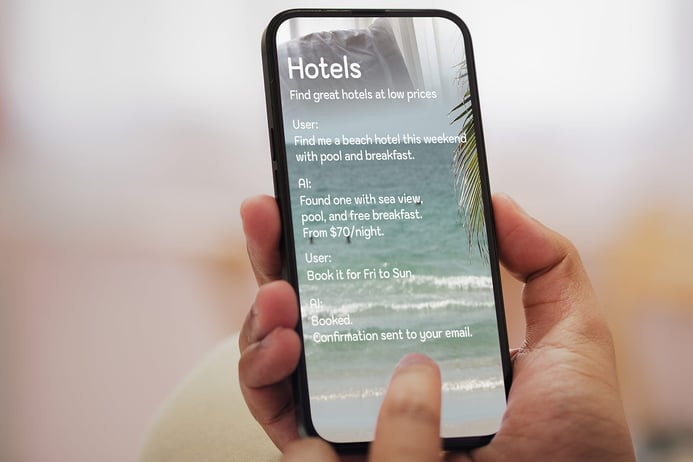
Too many choices. Too little patience. Travelers are overwhelmed, and operators are under pressure to deliver flawless experiences. AI in the travel industry is the game-changer positioned to rewrite the rules.
The biggest shifts are happening in the realm of online travel platforms and booking services, with significant implications for operators and travelers alike. This article explores how AI is used in travel today, the rise of AI-powered travel apps, and what it will take to build a truly integrated guest experience across sectors.
How is AI Used in Travel Today?
Artificial intelligence (AI) is reshaping nearly every stage of travel. AI tools are already present when travelers find inspiration for their trips, and when feedback is gathered after the fact.
As travelers are embracing AI to plan and book, their expectations for the journey itself are higher. In order to deliver a guest experience suited for today’s traveler, operators must understand how the environment is changing.
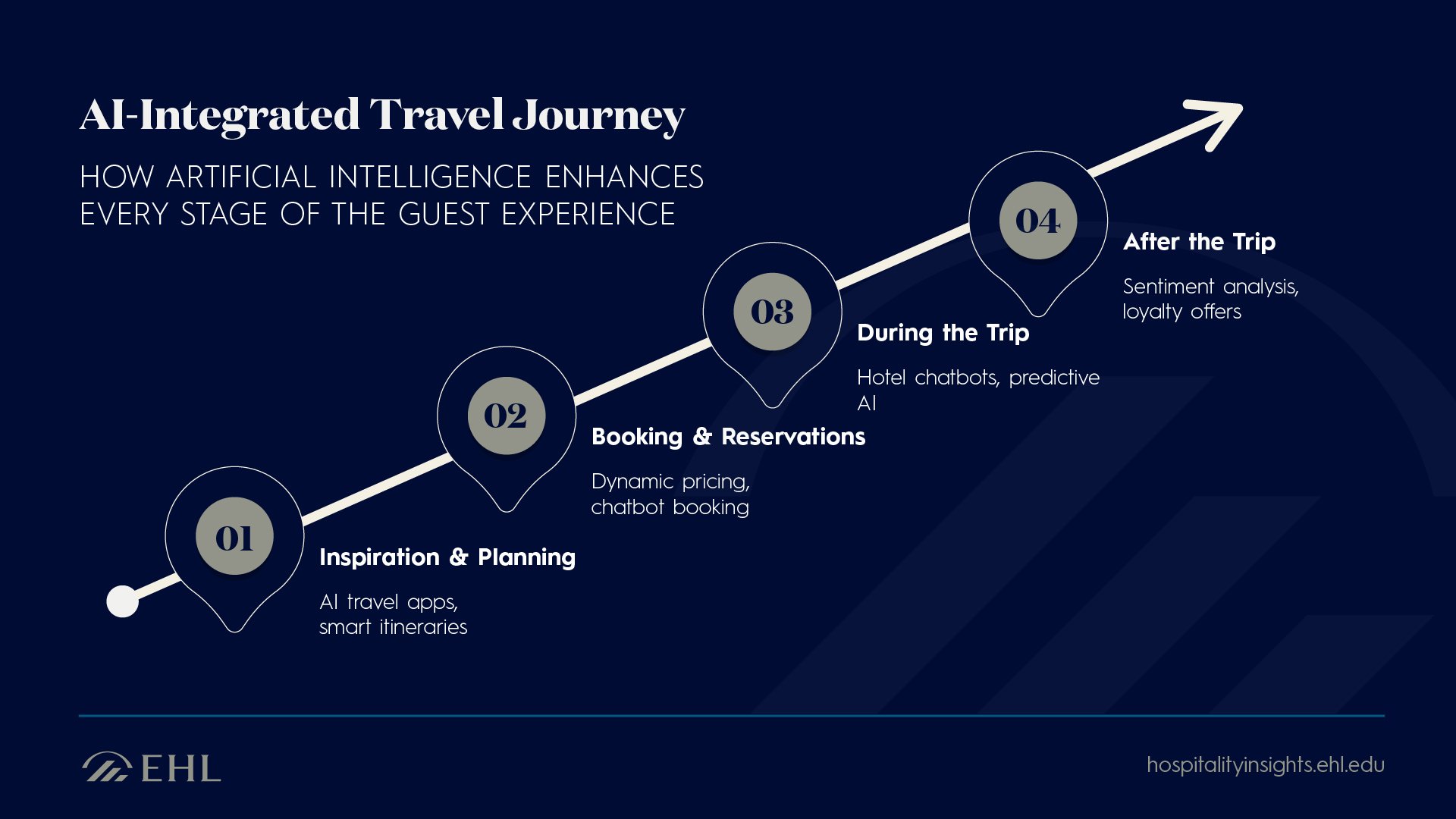
Inspiration and Planning
Today, travelers can use AI to gather inspiration for travel based on their preferences and travel history. Generative AI has made the process conversational and instant, as tailored itineraries can be created in seconds.
Fully AI-driven travel apps are surfacing to challenge third-party booking platforms.
Booking and Reservations
Hotels and airlines employ dynamic pricing, meaning that rates are adjusted in real time based on demand. With AI-driven price engines, this can be done by the minute.
Chatbots embedded on hotel or airline websites answer questions about cancellations, loyalty programs, or upgrades. AI is also increasingly present on online booking platforms.
During the Trip
Airlines and ground transport providers use predictive AI for scheduling, rerouting, and even anticipating maintenance issues before they disrupt travel. This serves to offer a more reliable experience to travelers who increasingly expect real-time updates and seamless journeys.
Destinations themselves are experiencing AI enhancements. Chatbots are also present in hotels, functioning as digital concierges that are available around the clock to answer guest queries about amenities or give recommendations.
After the Trip
Post-trip, AI supports travel providers in sentiment analysis. Reviews can be scanned at scale, and the gathered data is invaluable for operators so that they can spot what is not working and address service gaps.
Marketing is also personalized to a greater degree with AI. Campaigns are automated, and guest data can be considered to make sure offers are personalized and more impactful.
AI is touching nearly every part of travel but planning and booking are seeing the fastest change. Travelers are starting to skip the endless browsing and turn to AI apps to build their trips in seconds.
AI Travel Apps and Planners Are Reshaping Trip Booking
While travelers today have more options than ever when planning their journey, they are also experiencing decision fatigue. According to Accenture, 68% of travelers use up to ten different websites to plan a single trip. This also comes at a detriment to operators, as 74% have abandoned purchases because of the complexity of choice.
Online travel agencies (OTAs) infamously hold the upper hand in the travel industry in terms of distribution, accounting for 35% of hotel bookings globally. Rumor has it, however, that giant booking sites such as Booking.com and Expedia are worried about the shift brought about by the use of AI becoming more widespread.
AI promises ease in the booking phase, addressing a real pain point for overwhelmed consumers. Travelers are increasingly using generative AI tools such as ChatGPT to plan their next trip, and the allure is easy to understand. By giving prompts such as ‘I want to take a 4-day vacation to location x and spend my time doing activity y’, users can receive detailed itineraries fitted to their preferences in seconds.
While tools such as ChatGPT are not without their limitations when travel planning in the present day, as they are still often unable to pull accurate information from different sources, this will soon change with agentic AI. If autonomous bots can directly make bookings on behalf of travelers, it cuts out the need for OTAs as a middleman.
OTAs as the New AI Travel Apps
For many operators, the chance to bypass costly OTAs that charge commissions of 30% or more is a welcome shift. However, as booking platforms brace for impact, it’s still too soon to celebrate.
For instance, Booking.com has launched the AI Trip Planner, which can understand intent in the open-ended questions it is prompted with. Users can ask for specific information about properties that are not answered by static listing, and add their own, “smart” filters when discovering properties to stay at.
97% of travelers want a travel “superapp” that could address all their travel needs, from flights to transportation, destination ideas, attractions, and hotels. Furthermore, more than a third ranked personalization as their top desire for their travel planning experience.
Market-leading OTAs already possess outsized amounts of property data, making them well-positioned to respond to the demand from travelers who are tired of managing all variables related to their journey.
Now, users can tell these AI travel planners what they want, prompting the travel app with the budget they are working with and throwing in whatever wishes they have, such as a beach view with proximity to biking routes.
Given that 66% of travelers are dissatisfied with current planning and booking tools, AI-enabled booking experiences are becoming a competitive necessity for these platforms.

Tackling the Biggest Challenges in Travel and Tourism
With AI seeping into every crevice of the travel industry’s infrastructure, it is helping operators tackle some of the industry’s most persistent challenges: thin margins, labor shortages, and demand volatility. AI creates opportunities to address these structural challenges head-on.
Labor Shortages
Hospitality and aviation are notoriously labor-intensive and have a hard time holding onto skilled staff. AI systems can automate many repetitive tasks and improve the efficiency of staff.
Customer service is the most impacted by AI, with an estimated 30% of traditional jobs in the area disappearing as a result. Upskilling the workforce to handle more high-value tasks is also a matter that AI training tools can help with.
Margin Pressure
Low profit margins are a defining feature of the travel industry, driving companies to relentlessly seek revenue optimization and efficiency.
Dynamic pricing originated in the airline industry, and this demand-based pricing strategy has later become an accepted practice in setting hotel rates. Predictive AI tools are now used to supercharge the process of setting the optimal price. For instance, Hilton reportedly has boosted its revenues by 5-8% when implementing an AI-driven dynamic pricing engine.
Demand Volatility
The travel and tourism industry is sensitive to external shocks, whether it’s political unrest, weather events, or macroeconomic shifts. For example, international arrivals to the United States fell by 7% year-over-year in May 2025, showing how quickly demand can dip.
Because the sector is influenced by so many factors, demand forecasting is difficult and can result in operational inefficiencies and financial risk. Luckily, AI tools can scan huge amounts of data and spot changes early, which can give travel providers the chance to adjust staffing and prices before the problems hit.
Considering AI from the traveler’s point of view is, naturally, very important, also given that rising guest expectations is another notable challenge the industry is facing. That said, AI has incredible and promising implications for the very structures of the industry and can help providers tackle systemic issues, making the industry more resilient and attractive for investors.
The Future of Travel: Toward a Cross-Sector AI Hospitality Ecosystem
Travelers now expect seamless experiences through and through, including the digital touchpoints of the customer journey. Many providers are still using outdated software, with plans to make AI investments in the near future. Even when they are adopted, many AI tools still operate in silos, with a chatbot answering questions here and a revenue management system adjusting prices there.
The real power of AI in the travel industry would come from not only connecting the systems of a hotel, for instance, but also having systems communicate across sectors. Especially agentic AI that could take autonomous decisions and pursue objectives while interacting with its environment could enable an ultra-seamless traveler experience.
For instance, imagine a guest’s flight being delayed, prompting an automatic rescheduling of the airport transfer and adjustment of check-in time in the hotel’s system. This is the essence of cross-sector AI hospitality.

What is Federated Travel AI? Federated Learning in The Travel Industry
You may ask yourself, how is cross-sector AI hospitality possible, without forcing all providers into one centralized platform? This is where the concept of federated travel AI comes in.
To put it simply, federated learning in machine learning means that an AI model is collaboratively trained across different providers without moving all the raw and sensitive data into one place. In this way, federated learning addresses data privacy concerns related to AI tools.
Federated learning is an emerging AI trend that matters for the travel industry because:
- Privacy-preserving – no personal data leaves the local systems.
- Collaborative insights – organizations can benefit from a much broader dataset without revealing their own.
- Regulatory compliance – helps meet strict data-protection rules in travel markets.
To paint the picture, in a federated model for travel, this would mean that airlines, hotels, ground transport, and attractions could all keep control of their own guest data, but an AI could draw conclusions from different systems in a secure way.
That means that instead of one company owning an entire guest profile, there is an AI ecosystem that shares just enough information with other providers to create a seamless experience for travelers. In this way, federated travel AI would neither compromise traveler privacy nor competitive advantage between providers.
Interoperability in Travel
Interoperability is a non-negotiable foundation for federated travel AI. It refers to the ability of different systems and technologies to exchange information and work together smoothly.
The concept is already familiar in the banking world, where banks and financial institutions can share account data with third-party apps such as payment platforms through secure touchpoints (with customer consent, of course). In other words, different banks’ systems can communicate with each other and other apps by using the same data formats.
Legacy systems in hospitality and travel were not designed to talk to one another to begin with, but with new infrastructure where different systems have built-in touchpoints (APIs) and standardized data formats, the idea of seamless travel across sectors becomes more realistic.
Guest Trust and Privacy Expectations
As the hospitality AI ecosystem expands, one of the most important questions is how much travelers are willing to trust it. Guests want the convenience of personalization, but they also want control of their own data.
Research shows that while over a third of travelers rank personalization as their top desire for their travel planning experience, the same number of consumers are “very concerned” about how their personal information is handled when interacting with travel websites. This is a tension that is widely recognized to be at the heart of AI adoption for travel providers.
The good news is that guests are willing to share data when they feel that there is a clear value in the exchange. For example, when an AI travel app uses information about loyalty to recommend relevant upgrades, or when a chatbot solves an issue instantly.
Transparency is crucial. Guests should know how their data is being used and how they can opt out. Earning traveler trust starts with prioritizing responsible AI and clear communication about what privacy safeguards are in place.
Building a Hospitality AI Ecosystem
There is currently a gap between what the hospitality industry is capable of offering and what guests are expecting in terms of seamlessness across touchpoints. The opportunity for the industry lies in shifting from fragmented tools to shared intelligence.
For travel providers beginning to build their AI infrastructure, it is worth keeping this goal in mind from the beginning.
1. Centralize and Structure Your Guest Data
Guest information is still scattered for many travel providers, some of it still in spreadsheets. That makes it impossible for AI to see the whole picture.
Start by pulling the essentials (guest profiles, booking history, spend patterns, and feedback) into a single system. This should then be structured consistently so every system refers to the same fields. You can’t have a connected ecosystem if your own data is disconnected.
2. Connect Your Core Systems
Once your data is centralized, it is simpler to connect the systems related to the guest journey through APIs or middleware. This is your property management system (PMS), customer management system (CRM), booking engine, and any messaging tools.
Once core systems are connected, they create a backbone where every part of the operation is working from the same information, which is a great foundation to have even before introducing AI. It also serves as a foundation for possible future links between systems of different companies.
3. Establish Common Data Standards Internally
An ecosystem needs a common language. Standardizing your data formats, however, can be a time-consuming process of naming conventions and tagging. Nonetheless, it is what enables systems to communicate reliably.
Standardized data formats make internal data more AI-aligned, allowing it to make more accurate predictions. In the future, the data will be ready to plug into partner systems without confusion or translation errors.
4. Launch One Connected Use Case End-to-End
Instead of sprinkling AI everywhere, it is more effective to choose one use case that runs across multiple systems. For example, automated upselling that pulls room availability from the PMS and guest preferences from the CRM and pushes these tailored offers through your messaging platform.
These end-to-end use cases prove firstly that your internal network can work as a single system, and secondly, the value of thinking in a cross-departmental way.
5. Build a Cross-Functional “Ecosystem Team”
AI should not be purely treated as an IT project. In order for the investment to be worthwhile, it needs to address real inefficiencies or optimization opportunities that have been recognized in different departments.
Internal barriers should be broken in a way where people from operations, marketing, revenue, and guest experience can ‘own’ AI projects together. This is the cultural groundwork that will enable external collaboration later.
An ecosystem is about people just as much as it is about tech. It is not enough to break the siloes between systems, but also between teams.
Where Travel Goes from Here
AI is already present at every stage of the travel journey. A major current shift for both travelers and travel providers is related to the rise of AI travel apps. For hospitality and travel operators, the rise of AI travel apps cuts both ways.
On one hand, they raise guest expectations for what travel should look like, that is, fast, conversational, and personalized. On the other hand, they may shift power even further towards large booking platforms where visibility is algorithm-driven and margins are squeezed because of commissions.
That said, the upcoming changes that AI could enable would run much deeper than this. AI could solve some of the industry’s most persistent challenges, such as labor shortages and growing guest expectations (a pressure it is ironically adding to).
Furthermore, the idea of a cross-sector AI hospitality, where every sector from aviation to hotels is connected, is no longer utopian with the advancement of this technology.
While ultra-seamless travel is still not a present-day reality, travel providers and hospitality businesses can start to gear their operations towards federated travel AI. When data is standardized internally and a more fluid infrastructure is built where systems can communicate, it sets the stage for interoperability across sectors.
All in all, the travel industry will continue to experience shock waves as AI technology continues to mature. Travel providers can harness new solutions for internal pain points, and with agility and innovation, be at the forefront when AI in the travel industry steps into a new era defined by seamlessness and personalization.