Ask ten people what makes a hotel truly luxurious, and you'll get ten different answers.
But speak to the general managers and guest relations directors actually running Paris's palace hotels, and you’ll see an entirely different picture: one where the word "luxury" has become almost too broad to be useful, and where the real differentiator is harder to commodify.
The luxury hotel market has changed. It has expanded, fragmented, and attracted new ownership models, new competitors from Asia, and new entrants from fashion and retail who see hospitality as a natural extension of their brand.
Palaces that once rested on their heritage have had to reinvest heavily just to stay relevant. And a generation of guests has arrived that isn't necessarily impressed by chandeliers, because they've seen plenty of chandeliers.
What does luxury actually mean, then? This article draws on conversations with hoteliers at some of Paris's most storied properties to find out.
What Makes a Luxury Hotel?
A palace or a 5-star hotel? Hotels around the world are often referred to as palaces or "grand dames": vestiges of a bygone era when grand hotels were associated with luxury and glamour. But the concept in its true sense is quintessentially French and in 2010 the French Tourism Office bestowed the title on establishments that met certain specific criteria.
So what makes a palace different from a 5-star hotel today, or for that matter, a 6- or 7-star establishment, although there is no official category as such?
Luxury can be defined rationally based on high ticket size, but also, there has been a redefinition of “ultra-luxury” as “back to basics” with a focus on authenticity: establishing real one-on-one relationships, personalization, uniqueness offered through artistic design, and quality in all things.
The Forbes Travel Guide, which independently rates hotels, defines “elements of luxury” as one of their main evaluation criteria. According to Chris Fradin, Vice President Europe for the Forbes Travel Guide, these are “standards that reflect detailed attention to the level of sumptuous comfort, choices and convenience provided.”
In luxury, things can be more powerful than words. Service. A view. Something you don't expect. Something more than you’d expected. It's the ‘wow!’ factor that goes beyond expectations and can be translated into a number of things, in many different ways.
It can be as simple as cleaning the guest’s glasses during turndown or replacing the empty chewing gum box in a guest’s car. Creating a wow factor really depends on the situation”, he adds. “It will be specific to each individual guest based on their expectations, habits, culture, background…
- Sébastien Chebaiki, Hôtel Plaza Athénée in Paris

"Luxury Hospitality" As an Overused Term
The definition of luxury hospitality is constantly evolving, and according to some, the word itself may have run its course as a meaningful descriptor.
Everything is luxury.
I don't even think that we should call ourselves luxury hotels anymore. Because if you look at it from a hotel perspective, even a small 3-star hotel can be ‘luxury’. Everything revolves around luxury. So I think it's about personalization. That's where I think you have a winning factor. Because today, money and the world have changed.
The reasoning behind this isn't cynicism, but rather it’s arithmetic. The global hotel market has expanded enormously over the past two decades, and with it, the baseline of what guests encounter and expect has risen sharply.
Twenty years ago, we didn't have all the hotels that we have today. Twenty years ago, one wouldn't have thought of investing this kind of money in a hotel. Back in those days, you'd have a 100-square-meter room and you'd think "wow!". But now you have them in the thousands. Because the world has gotten richer, money has become more diluted.
If price and physical scale no longer reliably signal luxury, personalization becomes the only differentiator that can't be easily replicated at volume, which is precisely why the hotels still regarded as genuine palaces invest so heavily in knowing and anticipating each guest individually.
Evolution of Luxury Hospitality and Service
The clientele for luxury hospitality has changed. Palaces are no longer reserved for the super-rich and famous. Expectations have changed too.
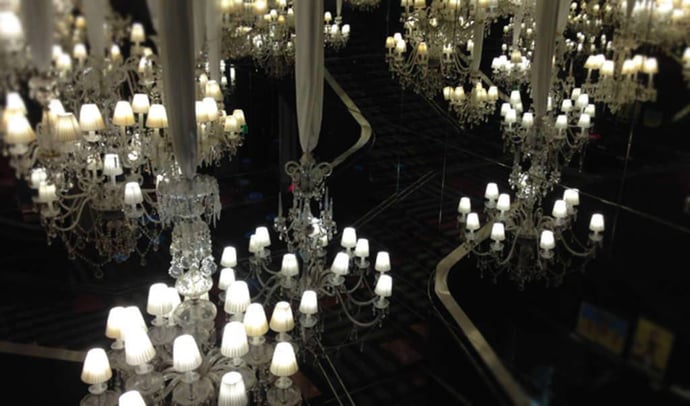
The Philippe Starck Chandeliers at The Royal Monceau Paris
Everything you do must reflect luxury, says Frank Schuetzendorf, who was previously the F&B Director at the Hôtel Plaza Athénée in Paris. You’re not compromising or cost cutting. A level of investment is required to deliver the quality and service, the experiences expected with luxury. It’s about doing things right, the attention to detail, following through on everything.
It’s about going above and beyond what you’d get with a standard 5-star (hotel). It's beyond stars. Things may go wrong but it's beyond those things too.
Like in many other sectors, the hotel business has jumped on the luxury bandwagon. New competitors, ownership structures, and business models are emerging: boutiques and collections; independent and family-owned, or corporately-owned and managed with different ownership and management strategies.
They adopt a mix of branding strategies that include “soft” and “hard” approaches, as in visible or invisible parent or group branding, such as the Luxury Collection – Starwood Hotels & Resorts (now under Marriott International) versus the Autograph Collection (no mention of Marriott hotels and most people seem oblivious of the brand’s ownership).
There’s no plaque on the door and no group logo. It builds on the individual brand’s unique identity as opposed to that of the group, yet benefits from the scale of a larger group while retaining, to a certain degree, their "independence".
Even luxury brands with no credentials in hospitality (Bulgari, Gucci, Armani) have extended their brands into luxury hotels, bars, and restaurants to enhance and further build relationships with their clientele and offer experiences and services that typify the brand.
Bulgari, for example, moved into hotels and resorts as part of a joint venture with the Luxury Group: a division of Marriott International.
Back in 2010, LVMH established a luxury hotel management division to manage its luxury properties and hotel activities recognizing the opportunity the high-end luxury hotel industry represented.
Maisons Cheval Blanc was a result of this; a concept pioneered with the Cheval Blanc resort in Courchevel and extended to the Maldives, Saint-Barthélemy, Saint-Tropez, and Paris, with talk of properties opening under the Cheval Blanc name in Oman and Egypt.
They all recognize the potential importance of hospitality within the context of luxury, an opportunity to provide unique personalized brand experiences and exceptional service. Many of the luxury hotels and grand palaces in France, not least Paris, rested on their laurels at the end of the last century.
Lacking investment, many lost their luster. But, as societies have become wealthier and the “luxury” client evolved and fragmented, culturally, geographically and demographically, it has reawakened the luxury hotel industry.
The result: extensive investment and renovation of luxury hotels. For instance, in Paris, the Ritz was closed for renovation work for four years to stay “in the game”. Hôtel de Crillon, recently acquired by Rosewood, is still closed.
Can Boutique Hotels be Classed As Luxury?
Boutique hotels can offer a different kind of experience that is just as much luxury: more customized, creating a unique and very personal one-to-one experience.
With fewer rooms than a luxury hotel (often around 40 keys versus 100 or more), the boutique can provide a different level of service that makes up for not having all the facilities of a large hotel with a spa, choice of restaurants, or 24-hour room service.
Chris Fradin of the Forbes Travel Guide says what counts is “the quality of the service and more intangible measures that allow small luxury boutique hotels to be compared with large hotels that have all the facilities.”
He adds, "It’s about creating a priceless experience that is increasingly seen as 'luxury' particularly among baby boomers and the new generation of “luxury” clients.
It involves the extensive use of storytelling that is personal, with the serving of traditional food and use of recipes of the owner’s grandmother, stories that bring the hotel’s heritage to life, as well as involving the guest in the local traditions and culture.
It’s a totally personalized experience.
The chef visits around breakfast time and asks what you'd like for dinner. He then goes out to the market and sends you photos of the fresh fish or invites you to tag along.
They overcome the lack of different facilities, by offering customized, personalized experiences that money can't buy.
It’s a more ‘home-from-home’ experience. There’s no check signing. No menus.
It’s much more customized and personal. Honesty Bars in the lobby is part of this experience: you serve yourself, just like you would at home.
Small hotels can just as easily offer a ‘luxury experience’ in creative ways.”
-Omer Acar, Managing Director, Europe, Katara Hospitality
Being Remembered and Talked About
Katje Henke, General Manager of The Peninsula in Paris, believes that when you get into a certain price category, guests expect more than design and location, and rightfully so. “If it was that easy, why wouldn't everyone be able to do it?”
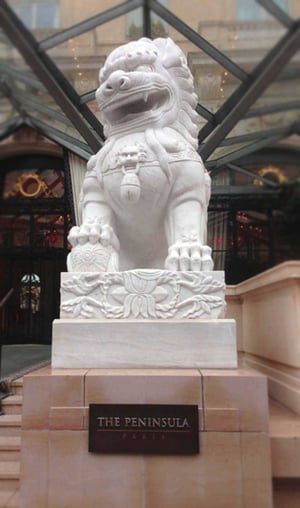
The Peninsula Paris entrance
So what is it beyond design and location that allows a hotel to charge premium prices?
François Delahaye, Chief Operating Officer of the Dorchester Collection and General Manager of Plaza Athénée, Paris, was appointed by the French Tourism office to head up the delegation for conferring the official “Palace” status in France. He says that for him, a Palace is linked to heritage.
A Palace often has high ceilings, a distinctive location and a large number of rooms. It needs to be at least, around, or above 100, to sustain the level of service required, with the adequate number of employees.
At Plaza Athénée, we have 100 chefs, even if they may not all be needed. But , at 2:00 am, for instance, it's important to be served a Dover sole or a fillet of beef, prepared by a chef and not done by the concierge who would have put on an apron to cook. That would be ‘bricolage’ (do-it-yourself).
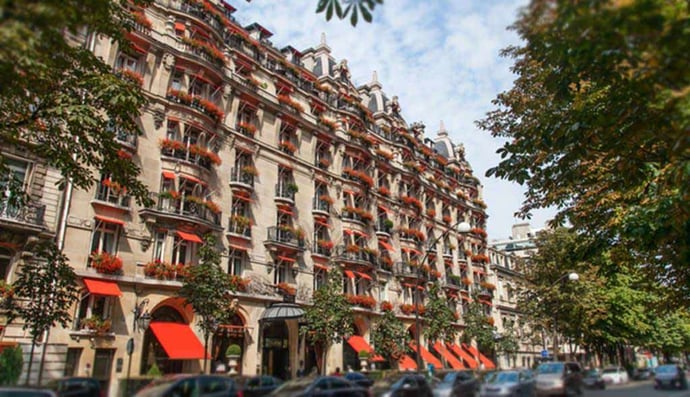
The Hotel Plaza Athénée Paris - street view
Katje Henke believes that palaces and luxury hotels are special, beautiful, and a little over the top here and there, as they are the products of exquisite craftsmanship and materials.
Luxury is when I get exactly what I want, when I want it, and how I want it, before I’ve actually asked for it.
According to Hotel News Now, when Hotel Barrière Le Fouquet’s was awarded "Palace" status in 2006, the hotel’s general manager Eric Boonstoppel said he identified seven criteria critical to such a hotel’s DNA: history and tradition, location, exceptional service, flawless product, first-class facilities, an haut de gamme (upmarket) restaurant, and price consistency.
Many of the traditional palaces were left off the original list released in 2010. Some were then re-evaluated as it was believed to be “nonsense” that the George V, for example (since acquired by Four Seasons Hotels and Resorts), was not included.
Most have since undergone extensive and costly renovations in order to be able to claim the official distinction, particularly in light of new luxury hotels from Asia entering the markets, namely Shangri-La, The Peninsula, and the Mandarin Oriental, and the increasing competition generally on the Parisian luxury hospitality world.
The new entrants, the Asian luxury hotels, have also achieved the “Palace” title without the traditional palaces' French heritage and culture.
They are not always located in old historic buildings steeped in heritage either. However, they can count on Asian aesthetics and renowned service to attract European, American, and Middle Eastern travelers and, for now, they have the official “Palace” title, which bestows recognition and is highly prized, as it can be leveraged in terms of sales and marketing.
It also involves an individual interpretation and expression of innovation and quality, and defining how they will deliver it, which is unique to the brand and is then built into their service philosophy and values. For example in the Parisian Context:
- Hôtel Plaza Athénée: Adopting the haute couture address, given its location and association with Christian Dior, to differentiate it from other palace hotels claiming to be “Parisian”, and embracing a vision of: “Once upon a time, the palace of tomorrow”; the color red (e.g. red geraniums, blinds, and sun shades); embracing both its Louis XVI-inspired décor and Art Deco traditions.
- Philippe Starck, showing respect to Salvador Dalí), reference to the Tuileries opposite with the color green and cut-grass fragrance; and its UK heritage due to its founder, Mr. Charles-Augustin Meurice (a postmaster operating transportation from London to Paris).
- Ritz Paris: Celebrating the glitz it’s renowned for in terms of gold fixtures and fittings, including the swan taps and room key; the blue and traditional colors (pink, yellow, green, and light brown); its relationship with Coco Chanel and other famous guests (such as Charlie Chaplin, Ernest Hemingway, Marcel Proust, and F. Scott Fitzgerald); staying true to its location, spirit and heritage, its Louis XIV architecture and furnishings.
Luxury Hospitality and The Ego
François Delahaye, Chief Operating Office, Dorchester Collection and General Manager of Plaza Athénée in Paris explains that luxury hospitality in this media-dominated world is all about ego and living up to the image you wish to project. He explains:
We are in the ego business. Whether the employee joining us is proud to list us on his CV, or the owner and guests are selective about high profile properties to invest in or stay at.
Those three pillars, employees, owner and guests, are sensitive to where they work, what they acquire or where they stay.
It's a candid framing, but one that reorients the entire conversation. Strip away the thread counts, the Michelin stars, and the heritage narratives, and what remains is a three-way agreement between a hotel, its staff, and its guests, each needing the association to mean something. The product is the prestige, and the prestige only holds if everyone in that triangle believes in it.
Summing Up
Whether new or old, traditional or modern, boutique or 100-plus rooms, independent or corporately owned, luxury is about creating a unique and magical experience like no other.
A “wow!” that feeds the ego of everyone. The vision for Hôtel Plaza Athénée (Paris) says it all. "Once upon a time, the palace of tomorrow: the splendor and the intimacy, the hospitality and the décor, the past and the present."