
Over the last quarter of a century, society has undergone unprecedented change, and our world is now almost entirely digitally driven. In the hospitality industry, guests now expect to book rooms, check in, access amenities, and settle bills using technology, with most of it hinging on the internet and phone apps.
There’s no denying that this digital evolution brings unprecedented convenience, but it also opens the door for cybercriminals to strike.
In the hospitality industry, cybersecurity has become a central issue that affects how hotels protect sensitive guest data, preserve their brand integrity, and ensure uninterrupted operations.
Seeing as hospitality businesses act as custodians of enormous volumes of personal information, it’s no wonder that they’ve also become prime targets for cyberattacks.
Catastrophic security breaches like the Ashley Madison hack of 2015, which exposed sensitive data from over 30 million users, and the more recent leak of 16 billion login credentials tied to major platforms like Facebook, Google, and Apple show just how vulnerable even large-scale systems can be.
In hotel cyber security terms, this means that even trusted online public platforms can fall short, and there’s an urgent need for robust infrastructure and proactive risk management.
Why Hotel Cyber Security Matters More Than Ever
Due to the very nature of their operations, hotels are uniquely vulnerable to cybercrime. On any given day, they collect and store a vast amount of sensitive information, ranging from passport scans and credit card details to booking histories and business affiliations.
If the hotel cyber security protocols are outdated or inconsistent, hackers may view these systems as low-hanging fruit.
What makes the situation even more concerning is the high volume and turnover of users interacting with hotel networks on a daily basis. There are guests connecting to the public Wi-Fi, employees logging in to multiple platforms, and services relying on real-time data processing. All of this creates a broad surface area for hackers to potentially attack.
The risk is very real, as the hospitality industry is consistently ranked among the top targets for cybercrime. According to a PwC report cited by Vingcard, hotels are second only to retail in terms of attack frequency, which only underscores the need for comprehensive hotel cyber security strategies. Additional insights from UpGuard reinforce the sector’s vulnerability to cybercrime, mentioning repeated data breaches affecting major hotel chains.
Real-World Breaches That Shook the Hospitality Industry
The hotel sector certainly doesn’t have a shortage of cautionary tales when it comes to cybersecurity failures. Multiple high-profile data breaches have exposed everything from loyalty account credentials to credit card data and passport numbers, highlighting systemic gaps in hotel cyber security preparedness.
To this day, Marriott International’s 2018 breach remains the industry’s most notorious incident. Compromising the Starwood reservation system, investigations showed that cyber attackers accessed sensitive personal information of approximately 383 million guests.
Affected data included passport numbers, payment card details, and contact information. Marriott faced massive fallout, including regulatory fines of nearly £99 million (~$120 million) under GDPR, and additional legal liabilities seeking class-action damages up to $12.5 billion in the U.S.
While that’s the biggest breach, it’s not the only one. Hilton Worldwide disclosed a malware breach impacting its payment systems during two separate periods between late 2014 and mid-2015.
The malware captured cardholder names, card numbers, expiration dates, and security codes from point-of-sale (POS) terminals across various properties, including brands like Embassy Suites and Waldorf Astoria. Hilton later went on to settle with New York and Vermont state authorities for $700,000.
The Trump Hotel Collection also suffered a data breach that affected seven properties from May 2014 to June 2015. Malware deployed in their point-of-sale systems potentially exposed credit and debit card numbers, expiration dates, and security codes. While no confirmed misuse was reported, the breach led to customer advisories and fraud protection offers.
These events prove that due to large volumes of sensitive data, multiple entry points across connected systems, and often inconsistent security practices, hotels operate in an environment of perfect cybercrime conditions.
Each breach highlights critical weaknesses in hotel cyber security infrastructure, such as delayed response, inadequate network segmentation, and a failure to encrypt or limit stored data.
They also show that weak hotel cyber security is a vulnerability that cybercriminals repeatedly exploit, and financial penalties aren’t the only consequences.
Brand trust quickly erodes, guests lose confidence, and there’s long-term reputational harm. Marriott learned this the hard way, as recovery costs alone ended up in the tens of millions, and indirect losses pushed the total into billions of dollars.
The Hidden Weak Spots in Hotel Networks
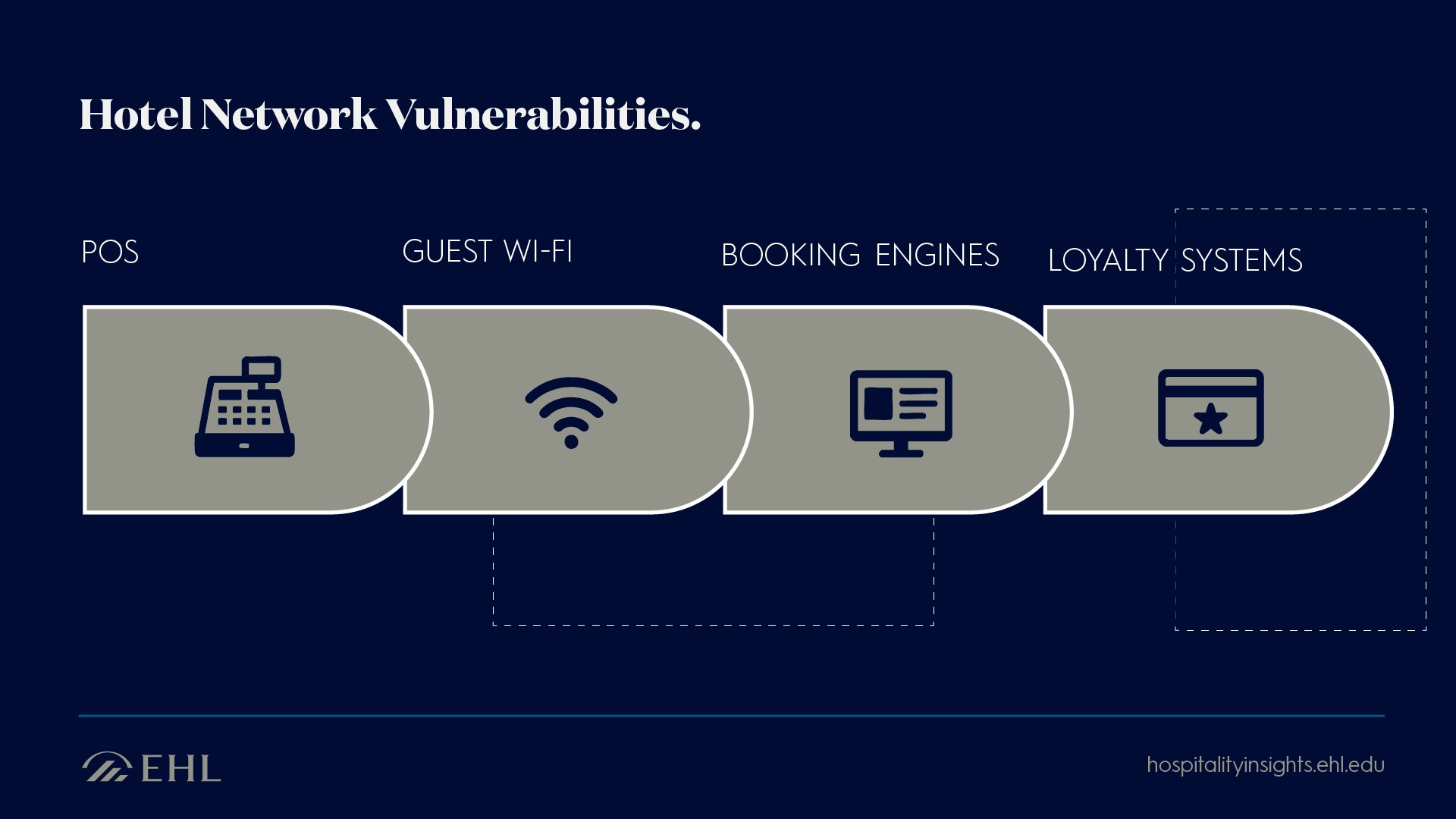
As outlined by TechMagic, to create a solid hotel cyber security strategy, you need to start by identifying where threats are most likely to surface.
POS systems used in bars, restaurants, and spas are vulnerable to malware that can capture card data during transactions, as these systems are often under-protected or overlooked during regular IT updates.
Public Wi-Fi is another potential entry point for attackers. Most guests already know this, but few realize the risks. Without proper segmentation and encryption, a guest logging on can inadvertently provide a backdoor to the hotel’s internal network.
Online booking engines, especially ones operated by third-party vendors, are also potential targets. If those platforms aren’t routinely patched and audited, hackers can use that to their advantage.
Even loyalty programs, often seen as mere marketing tools, can be used if cybercriminals somehow gain access to stored user data.
The Seven Most Common Hotel Cyber Security Threats
Hotels handle a constant flow of sensitive guest data, financial transactions, and interconnected systems, making them an attractive target for cybercriminals. While these threats come in many different forms, the following are the most common and damaging in the hospitality sector:
1. Malware
Malware (malicious software), is one of the biggest risks. From viruses that corrupt property management systems to ransomware that locks the entire booking platform until a ransom is paid, malware can bring hotel operations to a standstill. Obviously, this comes with potentially huge consequences, ranging from financial loss to reputational harm if guest data is exposed.
2. Phishing and Spam
Spam basically refers to unsolicited emails, usually in the form of advertisements or just digital clutter, but some are designed to deploy malware or redirect payments. Phishing emails will often appear legitimate and can trick staff into clicking harmful links or share login details. Since hotel employees process constant guest and vendor communications, it’s critical to train staff to spot suspicious emails and messages.
3. Denial-of-Service (DoS) Attacks
A denial-of-service (DoS) attack occurs is when a hacker or virus overwhelms hotel servers or network with traffic, shutting down websites, Wi-Fi, or reservation systems. Even short disruptions can frustrate guests, block bookings, and cause revenue loss. DoS attack victims are usually high-profile or have made unpopular statements. However, hotels with limited IT resources are particularly vulnerable.
4. Point-of-Sale (POS) Breaches
Credit card theft is a major threat in the hospitality industry. Hackers will often target POS systems in bars, restaurants, or front desks to skim card details, which can be devastating for both trust and compliance
5. Weak Wi-Fi Security
Hotel guests expect free, public Wi-Fi, but it’s also a prime target for cyber criminals. Unsecured or poorly configured networks allow hackers to intercept guest data, inject malware, or impersonate official access points. If the Wi-Fi system is compromised, it can turn into a brand-damaging incident.
6. Insider Threats
Unfortunately, not all hotel cyber security threats come from the outside. Disgruntled employees or careless staff may misuse access to sensitive systems, share passwords, or inadvertently download harmful software. With a high staff turnover in hospitality, insider threats are a serious concern.
7. Data Breaches
Data breaches are perhaps the most damaging of all the cyber threats hotels face. They occur when hackers manage to get access to large volumes of guest information, including payment details and personal identifiers. High-profile chains have suffered breaches impacting millions of customers, leading to lawsuits, fines, and lasting reputational damage. According to Malwarebytes, the most recent case happened in Italy, where potentially 100,000 scans of ID documents were stolen from hotels.
Creating a Culture of Cybercrime Resistance
Failing to prioritize hotel cyber security can potentially have serious consequences. We’re not just talking about financial penalties, either, but public scrutiny, loss of market share, and long-term brand erosion.
Creating a robust cyber defense is as much about the mindset as it is about technology, and hotel cyber security needs to be a core part of the business strategy, not just an IT responsibility.

According to hotel software provider Siteminder, that means securing guest Wi-Fi, enforcing strong password protocols, segmenting networks, and using multi-factor authentication for internal systems. It also requires routine system updates, real-time threat monitoring, and consistent vulnerability testing.
Ensuring that the employees are properly trained is equally important. Every team member, whether they work at the front desk or housekeeping, should be trained to recognize phishing emails, understand data handling protocols, and report anything suspicious.
Data hygiene is also a fundamental pillar of hotel cyber security. Hotels should routinely review their data retention policies to ensure they’re only keeping what’s absolutely necessary, as storing less data and encrypting what is stored reduces risk.
What Guests Expect in the Digital Age

Travelers are more informed, connected, and privacy-conscious than ever. According to Coursera’s overview of hospitality cyber security, guests expect hospitality providers to proactively safeguard personal information, such as email addresses, passport numbers, and payment credentials.
A 2023 report from LoungeUp reveals that 74% of consumers want more control over how their personal data is used, and 77% are concerned about data privacy. Guests now demand clear communication about data storage, consent management, and usage policies.
In response, hotels can embrace cyber security as a key element of the guest experience. Providing secure Wi-Fi with individualized logins, showcasing privacy certifications (like PCI DSS compliance or ISO/IEC 27001), and publishing user-friendly data protection policies can help build confidence.
In an age of sky-high expectations, fragile loyalty, and fast-traveling reviews, hotel cyber security has become one of the things that define guest satisfaction and operational credibility.
The Future Of Hotel Cyber Security: Tech, Trust, and Transformation

The cyber threats facing hotels are growing more sophisticated and persistent. Kurt Baker at Crowdstrike explains how cybercriminal groups now use Ransomware-as-a-Service (RaaS) tools.
These are ready-made ransomware packages sold or rented online, making it easier than ever for attackers to launch large-scale ransom campaigns without deep technical knowledge
Techradar warns that AI systems are capable of credential stuffing, reconnaissance, and automated social engineering. Not only does that make it easier for less experienced attackers to breach complex networks, but in the near future, we might see automated attacks at scale.
Ransomware gangs use AI chatbots to handle ransom negotiations, streamline extortion workflows, and manage threats to leak stolen data.
There are also generative AI-powered Phishing‑as‑a‑Service (PhaaS) platforms that enable attackers to automate credential-stealing campaigns with personalized emails and cloned websites targeting hospitality staff and guests.
These highly advanced cybercrime systems are raising the stakes for hospitality operators that are already struggling to stay on top of traditional systems.
Hotel cyber security is now forced to evolve from perimeter defense to intelligent detection, behavioral analytics, and real-time response strategies to stay ahead of a changing threat landscape.
Fortunately, this isn’t a one-sided fight, as the tools available to defend against these threats are rapidly improving, too, with biometric authentication, zero-trust network models, and behavioral analytics becoming increasingly accessible.
As we already mentioned, technology alone isn't enough to win the war, and success will ultimately depend on whether hoteliers embed cyber security into their culture, operations, and long-term strategy.
Staying secure means constantly being proactive, not just reacting when something goes wrong.
Hotel Cyber Security FAQ
Final Thoughts: The Business Case for Security
At first glance, hotel cyber security is about protecting data, but there’s more to it than that. It’s also about protecting your business, your people, and your reputation.
With digital interactions becoming more central to the guest experience, hotels need to show that guests can trust them.
All the new tech and gadgetry that’s become part of the industry, and even our lives, means cybersecurity must be treated with the same importance as service quality, cleanliness, and guest satisfaction.
Innovation and education are key, and hotels that properly handle security can take a good chunk of the market.