Not more than a decade or two ago, emotional intelligence and leadership weren't required to go hand in hand. However, our expectations of work and what it means to be a leader have shifted drastically since then.
Nowadays, most leadership and HR experts will tell you that emotional intelligence is one of the most, if not the most important skill for today’s leaders. And it's no different in the hospitality industry.
Operational and technical expertise are still essential, but modern organizations are increasingly looking for effective leaders who can create a positive work culture, encourage employee growth, and build strong interpersonal relationships.
In this article, we'll explore why emotional intelligence in leadership is so important, what it looks like to combine emotional intelligence and leadership, and which soft skills leaders should master to increase their leadership effectiveness.
What Is Emotionally Intelligent Leadership?
Emotionally intelligent leaders are leaders who are able to process, regulate, and perceive their own emotions, and to recognize, understand, and influence the feelings of others.
The term Emotional Intelligence was coined by psychologists John Mayer and Peter Salovey in 1990. Psychologist Daniel Goleman later progressed their work by researching the importance of emotional intelligence in leadership.
He suggested that although an individual’s IQ and technical skills are important, emotional intelligence is key to being a successful leader, and someone should not progress to an executive position unless they have a high level of emotional intelligence.
The Importance of Emotional Intelligence in Leadership
Emotional intelligence allows you to build meaningful relationships with your teams and other stakeholders and, through those, boost organizational success. One study found that organizations that prioritize emotional intelligence are 22 times more likely to be high-performing.
On top of that, emotionally intelligent leaders know how to improve behavior and business results, and they have a positive impact on their team's performance and attitude around work (source).
The presence of emotionally intelligent leaders plays such a big role in job satisfaction that employees with emotionally intelligent managers are four times less likely to leave their jobs (source).
The attitude of leaders towards those hierarchically below them has a lot to do with that. Employees who believe their leaders treat them with respect are 55% more engaged, 63% more satisfied, and 58% more focused on their jobs (source).
That’s what the numbers say, but in terms of workplace benefits, what advantages do emotionally intelligent leaders bring?
Effective Collaboration
Being able to inspire collaboration is an important part of effective leadership. Leaders with strong emotional intelligence create a psychologically safe space where team members feel confident enough to contribute and share their ideas individually and in group scenarios.
They play a crucial role in turning employees into better performers while keeping their wellbeing in mind and creating healthier cultures where collaboration can thrive.
Meaningful Relationships
Leaders with high emotional intelligence use empathy, active listening, and interpersonal skills to build trust and a rapport with their teams and other important stakeholders.
By listening attentively and reading the emotional reactions of their team members, emotionally intelligent leaders can harness the unique talents of each team member to help them improve their individual performance.
This leads to both positive outcomes for the company and higher levels of employee engagement and retention.
At the organizational level, emotionally intelligent relationship management allows leaders to get internal and external stakeholders aligned so they can more easily implement changes and move the business forward.
Constructive Conflict Resolution
Conflict is inevitable in any organization, but leaders with high levels of emotional intelligence can manage it and resolve it in a constructive and positive way. By staying calm, encouraging team members to express their views constructively, and listening to and empathizing with them, they can understand everyone’s point of view and find mutually beneficial resolutions.
Conflict management is just as important as conflict resolution. Leaders with high emotional intelligence recognize when stressful situations risk escalating and use effective communication skills to nip potential conflicts in the bud.
Effective Decision-Making
Effective decision-making is a vital part of any leadership role, and leaders who understand and manage their emotions effectively make better decisions. They consider the needs and perspectives of others, discuss issues openly with relevant stakeholders, and make decisions that create better outcomes and stronger relationships.

The Five Components of Emotionally Intelligent Leadership
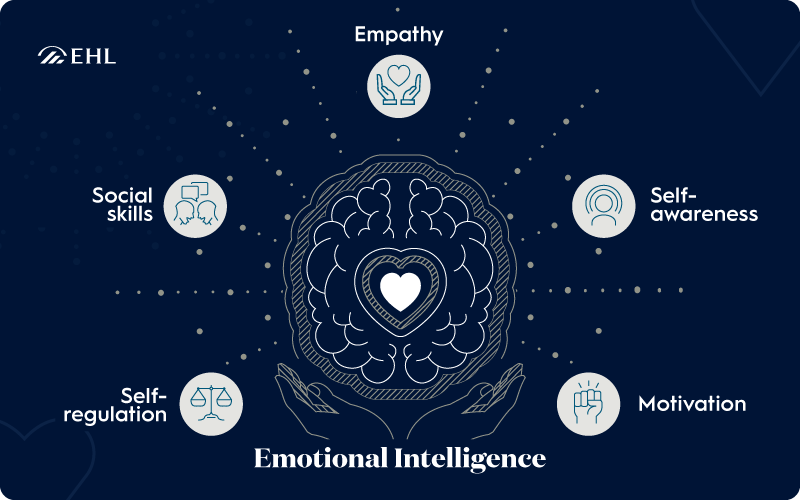
The psychologist Daniel Goleman identified five key characteristics of emotional intelligence (EI), which we’ll discuss below. These characteristics aren't fixed personality traits. You can improve them just like you can any other skill.
As well as increasing your leadership effectiveness, developing your emotional intelligence skills can drastically benefit your personal relationships.
The five components of emotional intelligence are:
- self-awareness
- self-regulation
- motivation
- empathy
- social skills
Goleman later grouped these components, which are also great leadership qualities, into four domains:
- self-awareness
- self-management (regulation and motivation)
- social awareness (empathy and organizational awareness)
- relationship management (influence, coaching, conflict management, etc.)
Let's have a closer look at the core components of emotional intelligence:
Self-awareness
Self-awareness is one of the most important leadership skills. Leaders with strong self-awareness acknowledge their strengths and weaknesses and know when to seek help when faced with a challenging situation. They know they have blind spots and are only human, so they develop awareness of how their emotions play a role in their decision-making and how they impact their own behavior.
This is the first step to effective self-management: self-awareness allows leaders to pause and reflect before their actions negatively impact others.
Genuine self-awareness is a rare skill, with research suggesting that 95% of people think they are self-aware, while only 10 to 15% truly are.
Self-regulation
Self-regulation is only possible when someone is self-aware. The most effective leaders recognize when they are getting angry, demotivated, or triggered and pause to process those emotions before they start to run the show.
Self-regulation is one of the most important skills a leader can have. It allows them to stay clear-headed without losing their humanity. After all, regulating your emotions doesn't mean ignoring them. It means acknowledging them and doing what you need to let them pass through in a way that doesn't impact others.
By practicing self-regulation, leaders are better equipped to manage conflict, deal with stressful situations, make hard decisions, and respond to challenges.
Social Social Skills
Hospitality leaders don't operate in isolation. They need to be aware of their wider work environment and the culture they operate in, and have excellent social skills to navigate both.
This also includes developing cultural intelligence and an understanding of the motivations and goals of different stakeholders.
Empathy
Empathy is the ability to understand and recognize how others feel and how your actions or decisions as a leader affect them. Empathetic leaders understand how to communicate in different situations and how workplace dynamics impact employee performance, happiness, and well-being.
Motivation
Self-motivation is what drives leaders who often don't receive a lot of external praise and are more often pressured than motivated to make progress. It also makes them resilient to potentially demotivating circumstances and committed to achieving their goals.
How to Develop Emotional Intelligence as a Leader

Working on your emotional intelligence skills is part of a lifelong leadership development journey that will benefit you just as much as those around you and the organization you work for. If you're up for the challenge, consider taking the following steps.
Assess Where You're At
Make an honest assessment of your current emotional intelligence. Before you look for a test online, take into account that you don't need to be highly intelligent to game these types of tests.
A better way to go about it is by gathering feedback from people you trust will be honest with you. That can be colleagues, your direct manager, or people who are close to you in your personal life. If you're already working with a therapist, they're a great person to ask as well.
To make sure you get good input, consider going through the following questions with them. You can also prepare by answering them for yourself as honestly as possible.
- What type of situations tend to frustrate me? When do I tend to get angry, impatient, or lose motivation?
- What do I do to process emotions like sadness, anger, and frustration? Are these methods helpful? Am I truly processing, or am I merely distracting myself?
- What do I know about the cultural background of my team members? What do I know about their individual needs, strengths, and weaknesses? (If you answer the same thing for every member on your team, that's a clear sign you need to work on understanding them better.)
- How are my relationships with vendors and other managers?
- Do I feel like my team trusts me and feels safe to come to me with concerns?
- When was the last time I listened to someone without immediately giving feedback or trying to fix their problem?
- Do I know how to get myself out of a slump? What actions do I take when I feel demotivated? Are these healthy? Do they have pay-offs?
Do The Work
Improving your emotional intelligence is a lifelong journey, but don't let that deter you. The more you progress, the more benefits you'll see. And you'll likely feel happier and more at ease on top of it.
Therapeutic modalities like Cognitive Behavioral Therapy (CBT) and Somatic Experiencing are great for understanding yourself better, and a certified counselor can help you identify which areas to work on first.
Regular therapy sessions can also help you process stressful situations at work and navigate challenges as you develop new ways of relating to your team and others in your organization.
One-off workshops and retreats can be interesting, but you'll only see a real difference if you work on your emotional intelligence as a leader consistently.
And if you're seeking out leadership training programs, make sure to choose one that also dedicates attention to social skills and self-awareness.
Experiment
Just like learning to ride a bike, you actually have to do it to be able to be good at it. Learning about things like regulation and social awareness won't make much of a dent if you don't start implementing those learnings on the work floor.
Don't be afraid to experiment and keep in mind that you won't get it right the first time. Your progress will likely look something like the following:
Something happens that makes you angry.
- You express anger.
- Two hours later, you realize you've expressed anger in a non-constructive way.
- You think about how you'd like to approach a similar situation in the future.
- The next time something makes you angry, you still get angry, but you notice in the moment what's happening.
- You take time after the event to reflect on what happened within you and decide how you want to act the next time a similar situation occurs.
- The next time something makes you angry, you notice the anger rising in your body, and you pause. If you can, tell the other person you need a moment and will get back to them. If you can't leave the situation, you'll take a breath, feel your feet on the ground, and maybe even make some movements to gain a bit of calm before you respond.
This process will look different for the various core components of emotional intelligence, and you'll grasp some of them more quickly than others. You're also likely to "relapse" sometimes as you're faced with bigger challenges. It's all part of it. What matters is that you see your emotional intelligence and leadership improving over time. Not in a direct line, but as an upward trend.
It's Time to See Emotional Intelligence and Leadership as One
Effective leadership requires a high level of emotional intelligence. Especially in the people-driven hospitality industry, leaders with great social skills who master self-awareness, social awareness, and self-management are essential for fostering collaboration, improving employee engagement, and driving business results.