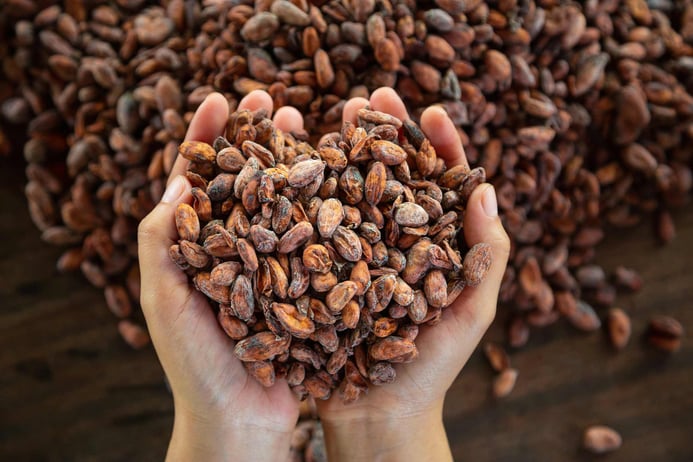
If you would like to know more about what ‘sustainable’ in cocoa production means, how it affects farmers and the environment, what companies do to improve, what challenges remain, and what the future of sustainable cocoa production might look like, you are invited to keep reading.
Sustainable Cocoa Production: What Does It Mean and Why Does It Matter?
Everything made of cocoa is delicious; chocolate, for instance, wouldn’t you agree?
Cocoa also offers benefits for heart health, brain function, and overall well-being, thanks to its natural sources of antioxidants and essential minerals. Yet another reason to eat more chocolate, right?
Even though it brings most of us sweet-toothed enthusiasts joy, the cocoa industry is one of the most challenging when it comes to fair trade and sustainability, the very issues sustainable cocoa production tries to address.
But what do we mean when we talk about ‘sustainability’ in general?
Sustainability: A Definition
Sustainability means meeting the needs of today's world, without undermining the ability of future generations to meet theirs. Keeping the balance by giving back as much as we take is at the core of sustainable cocoa production.
What ‘sustainable cocoa production’ looks like in practice, and why it is so important for us
Imagine cocoa trees growing under shade trees to conserve soil, store carbon, and support biodiversity. You can hear the birds and insects move through the canopy alive, while bananas or timber trees stand alongside cocoa to diversify income.
Instead of stripping the land bare, this farming practice, called ‘agroforestry’, is a hallmark of sustainable cocoa production: it looks and feels like a small forest, productive for farmers, but also protective of nature.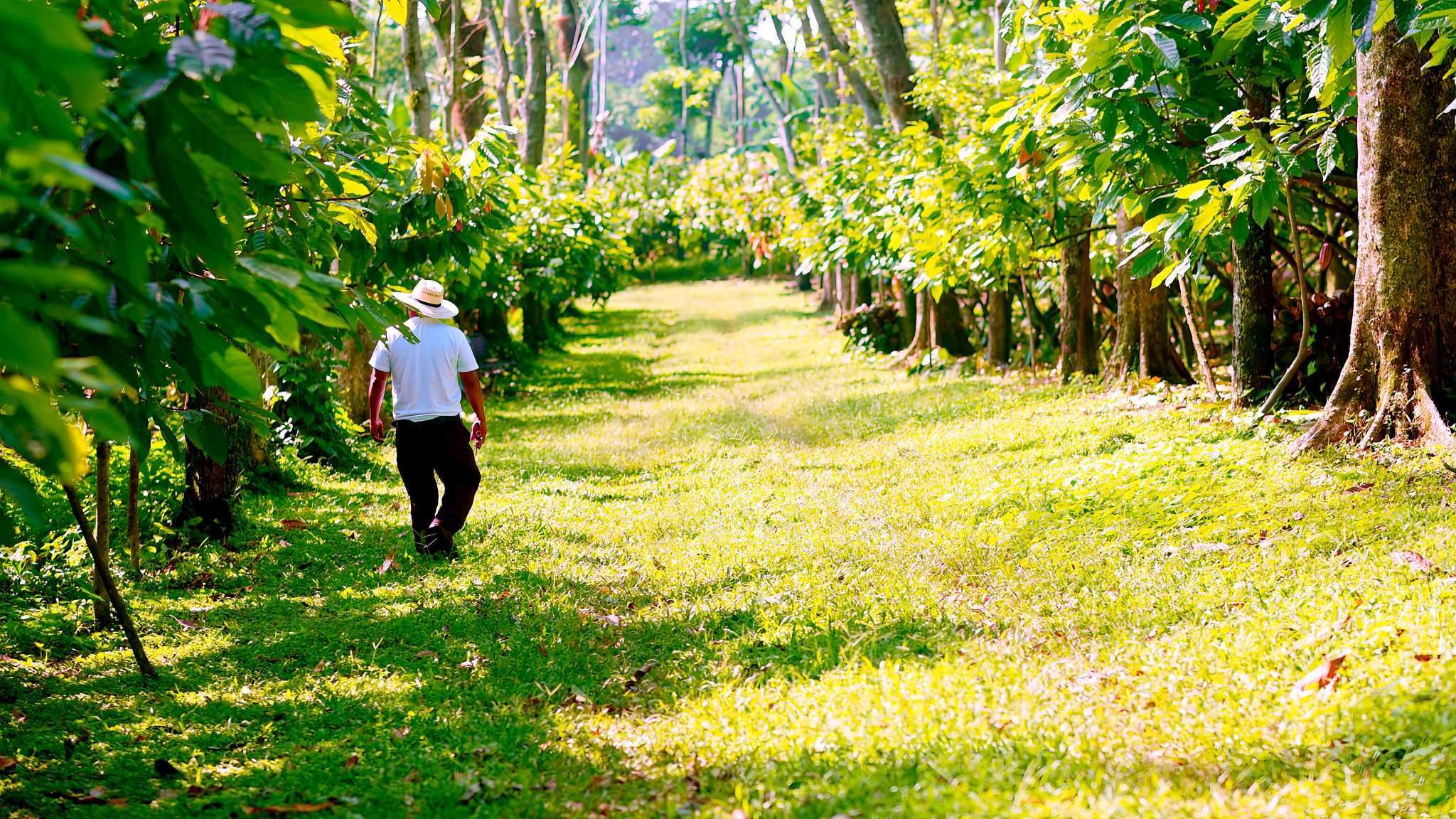 But sustainable cocoa farming goes beyond the landscape. It is about responsibly using farming materials such as pesticides in careful ways that nourish the cocoa trees without harming the soil, people, or the surrounding nature.
It is also about giving children the chance to grow, whether in school or through safe, age-appropriate experiences, while parents earn a fair income and communities build resilience through better wages and shared opportunities.
Sustainable cocoa production matters because, through it, we do not harm; we protect and create a future where we can thrive because nature is.
Challenges Facing Sustainable Cocoa Production Today
Although sustainable cocoa production is about balance, achieving it is challenging, because the scale of the industry nowadays makes it hard to control.
Imagine a million small farms across the globe and a complex supply chain, a chocolate market valued at over USD 100 billion (IISD, 2022), followed by a massive production of cocoa. In 2021-2022 alone, global cocoa output reached 4.9 million tonnes (Cocoa Barometer, 2022).
To put this into perspective, the amount harvested in 2021–2022 was enough to give every individual in Europe around 10 kilograms of cocoa beans.
The good news: Addressing these realities on the ground, ecological, social, and economic, is exactly what sustainable cocoa production is about. It helps us to tackle what’s possible and where support is most needed.
Let’s dive in.
Environmental Challenges
Let us take a mental flight over the humid forests of West Africa, the lush valleys of Latin America, or the rain-soaked landscapes of Southeast Asia. This is where cocoa grows, forests are cleared, soils are stained, and ecosystems are pushed beyond their limits.
Like palm oil and soy, cocoa belongs to the “forest-risk commodities” group, a category of crops that drive deforestation and land degradation in these tropical areas.
This is where sustainable cocoa production comes into play.
Instead of exhausting the land, farmers turn to mulching, crop rotation, composting, and shade management to keep soils alive and trees resilient.
Yet there is a harsh reality: climate extremes, pests, and plant diseases often leave farmers with few affordable, safe options.
The result? A crop at the mercy of environmental shocks, and fragile ecosystems that often pay the price.
Social Challenges
Change of scene: Imagine millions of smallholder farmers and their families. Most of them live on less than two dollars a day. Although cocoa is a multibillion-dollar industry, the daily life of those who grow it remains a struggle.
More concretely: While chocolate fills supermarket shelves worldwide, farming communities often lack the most basic opportunities, like healthcare or school education.
Yet another reason why sustainable cocoa production is so important. It elevates individuals to earn a living income, gives children the chance to go to school, and enables communities to strengthen themselves for the future.
Economic Challenges
Now, let’s zoom out and move from the farm to the global marketplace. Picture the giant cargo ships leaving West African ports, carrying cocoa worth billions across the oceans, on their way to Europe, the U.S., and beyond.
On the other end of this chain, global price swings make the farmers' incomes unpredictable, leaving many families dependent on external support or seasonal luck, which makes the future uncertain.
But here is the upside: Fair pricing models, stronger farmer cooperatives, and transparent supply chains are part of what sustainable cocoa production can bring to life.
But how would that look in practice?
Have you heard about ‘the farm gate’? It’s the point at which farmers sell their products directly from the farm before they enter the wider supply chain, including traders, exporters, manufacturers, and so on. The ‘farm gate price’ is the price farmers receive for their cocoa beans when selling them.
Put simply, it’s the farmer's real income per kilo/tonne of cocoa, and traders and brands add their margins. This is how stability from the foundation can be created.
And the outcome? A cocoa industry that not only creates value on a global scale but also strengthens local resilience so that those who farm the beans have a stake in the future they contribute to.
This balance rests on three key pillars: Environmental, Social, and Economic Sustainability..png?width=2048&height=1500&name=Visuel-3-pillars-sustainable-cocoa-production_1%20(1).png) But how can companies and consumers know whether our chocolate bar comes from sustainable cocoa production?
But how can companies and consumers know whether our chocolate bar comes from sustainable cocoa production?
Sustainable Cocoa Certifications
Scene shift: Now, we are standing in front of the supermarket shelf filled with chocolate. You have probably already noticed the different labels on it: .png?width=313&height=229&name=Visuel-logos-sustainable-cocoa-production_corner%20(1).png)
Certifications like Fairtrade and Rainforest Alliance are examples of sustainable cocoa certification schemes that make sustainability visible to consumers.
They set standards for issues such as fair payment, safe working conditions, and environmentally friendly production.
These labels dispatch inspectors to cocoa-growing regions by independent control organizations like Control Union or Ecocert.
Envision them entering a smallholder farm in Ghana or Ecuador, inspecting the shade trees, examining the bean storage conditions, and following the beans from the field to the warehouse. These inspections are what stand behind the labels.
But do these certifications tell the whole story?
The response is: not entirely.
Sustainable cocoa certifications encourage the sector to advance and raise awareness of sustainability. They may suggest that people preserve forests, pay farmers at least a minimum price for their cocoa beans, and maintain soils without using artificial pesticides.
However, labels don't fully convey the truth about sustainable cocoa production.
As already mentioned, there are millions of smallholder farmers dispersed throughout Southeast Asia, Latin America, and West Africa. No auditing system can inspect every plot daily. The expenses of compliance, which range from maintaining records to altering operations, can be prohibitive for households that struggle to make a living on a meager income, and premiums meant for farmers don't always reach them.
In conclusion, those certifications can guide us, but they can’t cover it all. They help us navigate in the right direction. Still, we achieve meaningful change if governments set strong rules, if companies are held accountable, and if we as consumers see past the wrapper to the story inside.
The Future of Sustainable Cocoa Production
Now, the question is no longer whether sustainable cocoa production will change, but how. According to scientific studies from West Africa and beyond, there are five areas that will impact the path to 2030.
Agroforestry as the Backbone
Once more, let’s take a mental flight over cocoa trees flourishing beneath the canopy of taller shade trees, side by side with fruit or timber species. These cocoa agroforestry systems do more than just produce beans: 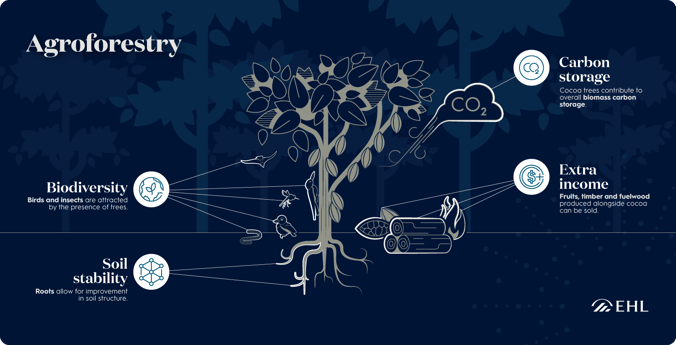
They preserve biodiversity, store carbon, stabilize soils, and provide farmers with additional income streams from fruits, fuelwood, or timber.
Recent research shows that farmers often weigh shade tree species not only for their ecological benefits but also for practical reasons like fruit harvests, market value, or ease of management (Asigbaase et al., 2025; Brown et al., 2025).
Scientists, on the other hand, tend to focus on species that best support ecosystem services such as pollination, soil fertility, or carbon capture. This difference in priorities can create a gap between ecological theory and farmers’ day-to-day realities.
The good news: participatory approaches, where farmers and researchers co-design shade tree mixes, are now emerging as a way to bridge that gap (Kristanto et al., 2025). They help ensure that cocoa landscapes are both ecologically resilient and economically viable.
In other words, Agroforestry means growing cocoa as part of a living forest. The future of sustainable cocoa production lies in finding the right tree combinations that work for both nature and people.
Climate-Smart Cocoa Farming
We’ve already touched on it: Cocoa is highly vulnerable due to rising temperatures, erratic rainfall, and pests. Research shows that climate-smart agriculture, which includes crop rotation, soil enrichment, and drought-resistant cultivars, will be essential, according to a Springer volume (2023). We can think of them as survival strategies in a climate-stressed tropics.
Sustainable cocoa production needs systems that are both productive and shock-resistant by 2030.
The conclusion: Cocoa is under pressure from climate change. Farming methods that adapt to extreme weather will decide whether production stays reliable for farmers and consumers.
Innovation and Knowledge Transfer
From Côte d’Ivoire to Nigeria, scientists agree: the future is digital, and sustainable cocoa production will not only rely on machetes and manual labour. Esan et al. (2025) show how training in pest management, improved planting materials, and digital tools already raise yields in Nigeria. Access to these innovations will be the key, especially for smallholders, for sustainable growth. Without farmers' knowledge and access, the best technologies remain unused.
This means better seeds, tools, and training can help farmers grow more with less effort. But only if these innovations actually reach them.
Fair and Resilient Farmer Livelihoods
Behind every bag of cocoa beans is a person, often a smallholder, stretching the income from their crop to cover food, school fees, and medical costs. A living income is therefore not just about survival; it is about giving families the security to invest in their farms and futures.
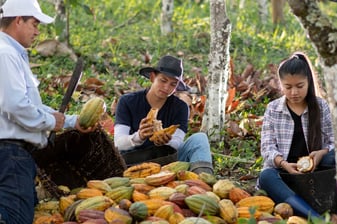
Research from the Springer volume (2023) shows that social sustainability, meaning access to education, gender equity, and fair opportunities, must go hand in hand with environmental goals if the cocoa sector, and with it sustainable cocoa production, is to thrive.
This reflects the broader idea of the Triple Bottom Line, where people, planet, and profit must be balanced to achieve true sustainability.
Conclusion: Sustainable cocoa isn’t only about trees, it’s about people. Unless farmers can live with dignity, the whole system remains fragile.
Policy and Shared Responsibility
Finally, science shows that farmers cannot carry the burden alone. Vroh et al. (2019) recommend incentives and payments for ecosystem services to reward sustainable practices, while Springer (2023) highlights the role of international policy (e.g., SDGs, the new EU deforestation law) in reshaping global supply chains. The responsibility for sustainable cocoa production must be shared among governments, companies, and consumers. It can’t be left at the farm gate.
The bottom line: Farmers can’t fix cocoa’s future on their own. Everyone, from companies to governments to consumers, has to play a part.
What Consumers Can Do to Support Sustainable Cocoa Production
At whatever issue we look upon, wouldn’t you agree that change comes when millions of small decisions are being made? Of course, broader industry and policy shifts are essential, but we as consumers decide in which direction we want to go.
Look Beyond the Wrapper
Next time you stand in front of the supermarket shelf, look for certifications like Fairtrade, Rainforest Alliance, or Organic, for example. As we found out earlier, they are not perfect, but they help set at least minimum standards. They raise awareness, and supporting them sends a signal to brands that sustainable cocoa production and sustainability in general matter to us as consumers.
Ask Questions
Whether you’re a hotel buyer, a chef, or simply someone who loves chocolate, ask your suppliers where their cocoa comes from. The more often we customers ask these questions, the more seriously brands take sustainability. Traceability creates accountability.
Support Ethical Brands
We can shift the industry of sustainable cocoa production by supporting smaller premium brands that work directly with cooperatives, invest in agroforestry, or pay living income premiums. That is also showing to larger companies that consumers reward genuine responsibility.
Value Quality Over Quantity
Instead of bulk buying the cheapest option, choose quality chocolate where a bigger share of the price goes back to farmers. Less can truly mean more when the impact on people and nature is considered.
Spread the Word
Hospitality professionals, in particular, have influence. When hotels, restaurants, and cafés explain why they choose sustainable cocoa, they not only educate their customers but also set a new standard in the market. The message is clear: sustainability is not a “nice-to-have,” it’s the baseline.
Key Takeaways on Sustainable Cocoa Production
- Sustainability is a journey, not a quick fix. Challenges are real, from deforestation to farmer poverty, but they are not insurmountable.
- Farmers, businesses, governments, and consumers all have a role to play. Real change happens when responsibility is shared across the value chain.
- Innovation and knowledge are spreading. From agroforestry to digital tools, new approaches are showing that cocoa can be productive and sustainable.
- People are at the heart of cocoa. Behind every bar of chocolate are farmers and families who deserve a fair livelihood and opportunities to thrive.
- The future is still open. With growing consumer awareness and stronger international commitments, the industry has the chance to turn sustainable cocoa production into a true model for sustainable agriculture.