
Whether you're for or against it, AI in the foodservice industry is seeing rapid adoption. Debates around AI in the foodservice industry have accelerated in recent years, but what is now crucial is clarity. In this article, you will learn where AI can actually create operational value, see how the business context shapes what “good” AI use looks like, and understand what leaders like yourself are invited to change to ensure your business is future-proof.
What Do We Mean by “AI” in Foodservice (And Why the Distinction Matters)
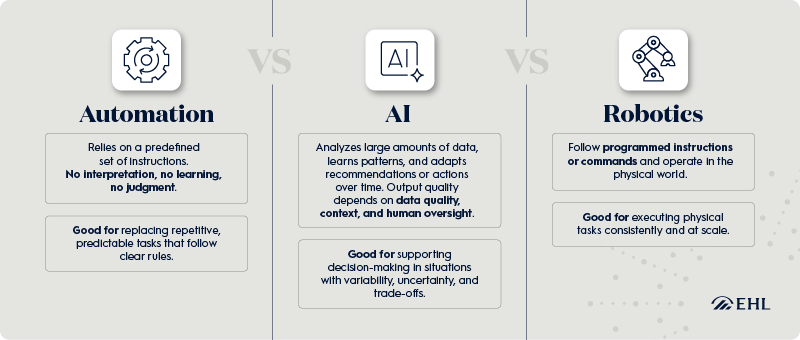
AI has become a buzzword, and in foodservice, it seems to have become an umbrella term for automation and robotics, but these terms are not the same.
Before discussing the operational value of these technologies, we need to clearly distinguish them:
- Automation follows fixed rules
- Robots are physical machines designed and programmed to carry out tasks.
- Artificial Intelligence (AI) refers to a software system that can comprehend and learn from data, make decisions, and improve its performance over time.
Although a robot isn’t AI, it becomes AI-powered if it can:
- Adjust cooking times based on ingredient temperature
- Modify portion sizes based on demand forecasts
-
Learn from past outcomes to improve taste, consistency, or efficiency
-
Respond to real-time sensor data rather than fixed rules
In simple terms: A robot is the “body,” and AI is the “intelligence” behind it. Understanding the difference helps us better evaluate which AI-driven innovations can truly improve performance versus those that simply add complexity.
In practice, however, impact depends less on AI itself than on how well foodservice businesses prepare their operations, data, and staff to use it to its full capacity. Before we get into this, it is worth taking a moment to step back and understand the context behind AI's growing traction in foodservice, as well as its parallel adoption in AI in food manufacturing and adjacent production environments.
Why Is AI Gaining Momentum Across the Foodservice Industry?
If you are an industry professional, you are familiar with the strain of doing more with less nowadays while ensuring a high-quality service to keep guests' experiences at the highest possible level. AI is becoming increasingly popular in the foodservice industry because it assists when restaurants are short-staffed, operational costs rise, and the need for greater efficiency grows.
It is not just trending because tech companies want to sell us something. This technology is providing us with the opportunity, if well utilized, to fill the gaps. Let's touch upon this below.
1. Labor pressure
Labor pressure is a real and significant challenge because staff shortages aren’t just seasonal but structural. Managers are forced to maintain their establishment’s service levels even when they lack sufficient staff.
To deal with this pressure, businesses are implementing AI-driven systems and scheduling tools.
According to data from quick-service and foodservice operators, AI-based scheduling systems can increase staffing efficiency by up to 30% and reduce labor costs by up to 12%, while automation and customer service technologies can reduce staff workload by up to 40%.
Academic research supports the functional relationship behind these outcomes. A 2025 empirical study of hospitality firms found that AI adoption does not significantly reduce overall employment levels but instead reallocates work by absorbing routine, administrative, and cognitively demanding tasks.
With that said, it is less about replacing people with robots than about relieving employees' cognitive overload with intelligent support, allowing staff to focus on what makes the hospitality and foodservice industry beautiful – connecting with people.
2. Cost volatility
Adjusting to unpredictable price changes is a well-known challenge across the foodservice industry: suppliers change prices, labor costs are rising, rent is increasing, and ingredient costs are spiking, making menu planning risky. AI systems can assist in analyzing these changes across purchasing, waste, and seasonality, providing operators with a buffer to make the necessary adjustments.
In the foodservice domain, AI-based sales forecasting models have been shown to reduce forecast errors by approximately 19–33% compared to traditional methods, making more accurate demand and purchasing planning possible.
By adjusting prices and allocating resources in response to real-time market signals, AI-driven revenue management and dynamic pricing systems enhance financial performance and help businesses maintain stability amid cost volatility, according to systematic studies in the hospitality industry.
Another interesting finding from a scholarly review from 2025 is that AI-powered demand forecasting and pricing are highlighted as key tools for enhancing profitability and controlling costs amid changing economic conditions.
3. Scale vs consistency
How to turn a first-time diner into a loyal customer? With consistency.
Consistency is the backbone of an establishment's reputation. Machine learning food applications can help identify patterns, such as peak dining times, popular menu combinations, and recurring guest preferences, for example.
It should not mean that robots are replacing the heart of a restaurant – the cooks – but rather that they are supporting your staff with information that was previously hard to see.
4. Data availability
If we were traveling 15-20 years back in time, most data was kept safe in people's minds, on paper tickets, or in simple systems. Nowadays, Academic research in restaurant analytics shows that datasets can be combined to support strategic and operational decisions. From menu design and reservation management to queueing and multi-channel order flows, helping restaurateurs uncover patterns that humans alone could not detect.
Moreover, systematic research on big data analytics in the food and hospitality sectors has found that AI and machine learning applications rely on large, complex datasets from across the value chain to generate actionable insights for inventory control, quality improvement, and process optimization.
Other machine-learning tools can extract meaningful sentiment and feature patterns from large volumes of customer feedback, enhancing managers’ ability to understand and respond to customer expectations.
Artificial intelligence thrives on patterns: when powered by vast, reliable datasets, it turns raw information into insights that help operators optimize operations, improve the customer experience, and adapt rapidly to change, an essential capability in the emerging smart food industry.
How Foodservice Leaders Can Prepare Their Operations for AI Adoption
Approaching AI in the food service industry simply as a technology upgrade rather than an operational shift might make things more complicated. The following principles outline how foodservice operators can prepare to deliver measurable value while protecting the heart of the business: hospitality.
1. Map how decisions are made during service
Before introducing AI, leaders must understand how their operation truly runs, not how it looks on paper.
That means walking through a full service from prep to close and observing where decisions are made under pressure, asking:
- How are prep quantities being set?
-
How is the labor adjusted?
-
How are bottlenecks being handled?
-
How are mistakes recovered?
Paying attention to moments where teams rely on habit, intuition, or last-minute fixes rather than clear standards.
Many of these inconsistencies come from deeper structural issues outside of service itself, especially in cost control and HR workflows, which heavily influence day-to-day decisions. As chef Patrick Ogheard puts it:
AI delivers value when it improves decision-making. If decision ownership, timing, or criteria are unclear, automation will only accelerate inconsistency, and AI will simply make bad decisions faster.
2. Clean up existing data before introducing new technologies
Data must be reliable before AI can recognize patterns and support better decisions. No advanced analytics are needed, but consistency is key. This includes:
- Having single standardized names for products across systems
-
Structured modifiers rather than free-text entries for customization requests
-
Documenting waste in real time
3. Begin with one operational challenge to tackle first
Whether it is frequent stockouts, misaligned working hours, or service bottlenecks, the objective is to focus on relieving a specific source of friction that clearly impacts margins or team morale. Once the challenge is identified, leaders can assess whether the issue requires better execution through automation or better decisions through AI-supported forecasting and decision support. Success measures should be specified in advance, and solutions should be tested on a limited scale before expanding.
4. Redefine roles before introducing AI-supported automation
A dominant concern regarding AI in the foodservice industry is the potential loss of employment opportunities. But rather than taking jobs away, AI will change how work gets done. This is why roles must be reconsidered so teams can work alongside AI rather than around it.
Therefore, it is key to be explicit about:
- What decisions will be made by the staff
- Where technology can support
- How judgment and hospitality are rewarded.
Automation changes who does the task, AI changes how decisions are made, and roles must be redesigned with both in mind.
5. Standardize what “good” looks like
Defining clear standards for execution, timing, and acceptable variation, whether it is in preparation service flow or what to do when something goes wrong, is what makes quality scalable and automation possible. Without agreed-upon definitions of “good,” neither humans nor machines can perform reliably.
Where to start:
- Prep levels for top-selling items: Decide how many of your highest-volume items to prep before service, when to replenish prep, and when to stop prep to avoid waste. Document it and use it consistently.
- Handoff timing during peak hours: Set a clear expectation for how quickly completed items must be delivered to the guest or delivery partner once ready. Assign ownership so food does not sit unnoticed during busy periods.
- Order accuracy checks: Define one clear checkpoint before orders leave the kitchen, with the assigned responsibility. Focus especially on modifiers and allergens.
- Service recovery for common issues: Identify the most frequent challenges and define a simple response: who owns it, what actions are allowed, and when to advance the case to the next level.
6. Encourage transparency and accuracy in day‑to‑day work
AI relies on accurate inputs and consistent execution. If teams are rewarded for behaviors that conflict with those requirements, the system will fail.
This dynamic is well documented in decision-support and information systems research, which consistently shows that poor data quality, including delayed, incomplete, or biased inputs, systematically degrades analytical outputs and leads to flawed operational recommendations, a phenomenon commonly described as “garbage in, garbage out.”
As an example, let’s take waste data:
If you are an industry professional, you know that performance evaluations are often tied to staying within a tight food cost range. When waste is logged accurately and in real time, food cost can appear worse in the short term, even if operations have not changed. To avoid negative scrutiny, waste entries are delayed, estimated, or skipped altogether.
AI systems interpret this incomplete data as lower demand and respond with tighter prep and ordering recommendations. The result is more stockouts, more last-minute fixes, and growing frustration within your team. When overriding these recommendations, the technology is blamed, when in reality, it was trained on distorted inputs.
To create value, behaviors such as honest waste logging and adherence to standards must be supported, not penalized. AI improves decisions only when the organization rewards transparency and consistency, not just short-term metrics, a finding consistently supported by empirical research on data-driven decision-making and operational performance.
7. Build ownership before introducing automation
Every AI-supported process needs a clear owner. Someone must be responsible for reviewing outputs, adjusting inputs, and escalating issues.
Assigning ownership at both the operational and leadership levels will make sure that AI becomes an active part of your business.
From Readiness to Results: Where AI Delivers Operational Value
AI in foodservice delivers the strongest returns by reducing variability, improving foresight, and protecting consistency at scale rather than replacing judgment or hospitality. But once these operational fundamentals are in place, how does that look in real-world cases, and where does AI actually pay off?
Demand and inventory planning
Two of the most consistent value drivers are AI-powered forecasting and inventory optimization.
Cornell University (with Willow) found that, with the assistance of AI systems specifically deployed to categorize food waste in commercial kitchens, leftovers can be reduced by up to 30% within months of adoption. This isn’t just good for businesses but also for the environment.
Academic research demonstrates that machine learning models applied to restaurant demand data can significantly improve accuracy over traditional methods, with documented reductions in waste of 14%-52%.
Compared with managerial heuristics, AI-based sales forecasting for a German fast-food franchise reduced prediction error by approximately 19%–31%, resulting in more accurate sales and inventory planning, according to a case study in a different research environment.
Operational efficiency and cost control
Some of the most consistently documented benefits of AI use in foodservice connect to improved forecasting and tighter inventory control.
Typically combined with point-of-sale and inventory management systems, AI-enabled inventory and forecasting systems analyze past sales data alongside external demand signals such as local events, seasonality, and weather. These technologies assist operators in better matching supply with anticipated demand by generating data-driven recommendations for food preparation and purchasing.
For example, empirical research shows rather compelling results: AI-based forecasting and waste-monitoring tools can significantly reduce overproduction and food waste. Compared with traditional estimation methods, reported reductions range from 20% to over 40% in commercial kitchen and catering environments.
Beyond inventory management, AI-supported scheduling and operational planning technologies can assist foodservice operators in aligning workforce levels with projected demand. This reduces labor inefficiencies, overtime, and last-minute schedule adjustments, allowing managers to focus more on operational execution and quality management rather than reactive problem-solving.
Guest experience that grows without undermining trust
Operators can speed up service and maintain brand values when AI is confined to support duties, such as managing routine queries, enabling predictive wait-time updates, or presenting personalized recommendations. Industry reporting shows that big chains are increasingly experimenting with speech AI and machine learning to increase order accuracy and throughput without sacrificing guest trust, even though specific named examples of guest-facing forecasting systems are less frequently published in peer-reviewed research.
Risk, safety, and compliance
Through compliance inspections and predictive monitoring, AI systems also support operational resilience. The underlying techniques, such as combining IoT sensing and machine learning to identify safety concerns or equipment failures before they get worse, are directly applicable to multi-unit restaurant environments and have been demonstrated to reduce spoilage and downtime, even though a large portion of this literature is in related fields (such as airline food safety).
What Leaders Need to Understand Before Applying AI
So what should we actually take away from these insights when we go back to leading our businesses tomorrow?
AI in the foodservice industry only works under very specific conditions, and we need to recognize this in order to drive performance and add operational value to our businesses.
- AI creates value where decisions already exist, but are made under pressure. When applied to recurring decisions such as demand forecasting and inventory planning, machine-learning models significantly outperform traditional methods, reducing forecast error and improving purchasing accuracy, rather than replacing managerial judgment, according to empirical research using real restaurant sales and operational data.
- AI depends on data quality and organizational behavior, not technological sophistication. A well-documented connection in research on decision support and information systems. It shows that delayed, incomplete, or biased operational data worsens analytical outputs and leads to poor recommendations. This is often called "garbage in, garbage out."
- AI amplifies what already exists - it does not fix weak operations. AI can improve performance mainly by reducing variability. Meaning lowering waste, stabilizing production, and improving forecast accuracy. Without consistent execution standards and data accuracy, AI systems will rather amplify existing inefficiencies rather than help to correct them.
In practical terms, the question is not whether AI is powerful enough. The question is whether the operation is clear, disciplined, and transparent enough for AI to be useful.