
Understanding the strengths and weaknesses of a hotel business is integral for making sure that your strategy is aligned with the capabilities and environment of your hotel.
This article explains what a hotel SWOT analysis is and how to conduct one, with a case study of the Louis Vuitton hotel in Paris at the end to illustrate the strategy tool in action.
What is a Hotel SWOT Analysis?
A hotel SWOT analysis is a framework designed to identify the unique strengths, weaknesses, opportunities, and threats of a hotel business. Dating back to the 1960s, it is still one of the cornerstones of strategic management.
At its core, the hotel SWOT analysis allows hotel businesses to recognize what their competitive edge is, what areas for expansion remain untackled, and what should be addressed to ensure the longevity of the business.
The Four Components of a Hotel SWOT Analysis
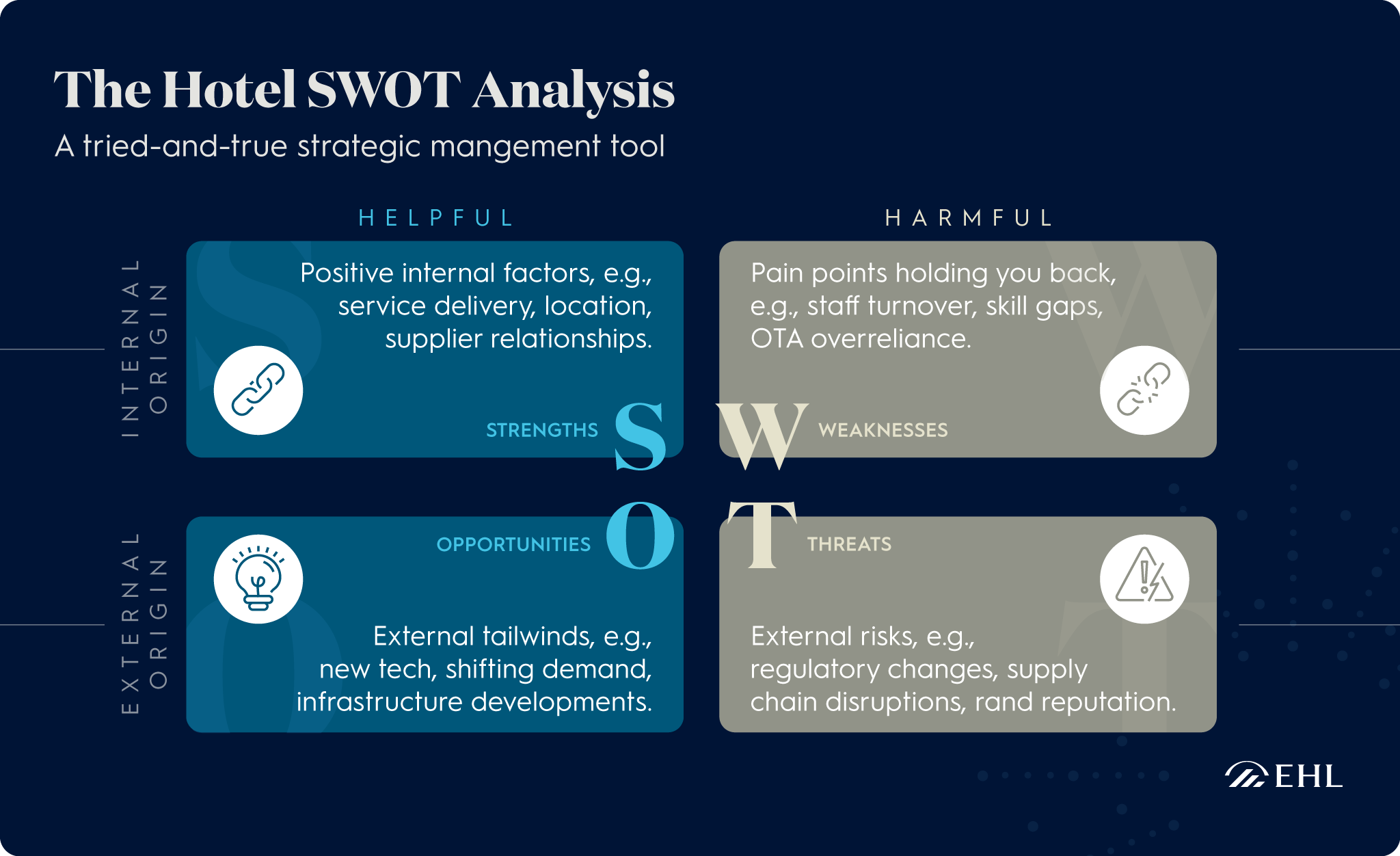
The hotel SWOT analysis comprises four components. The findings are most often presented in a grid format, with each occupying its own corner.
Here is an overview:
- Strengths: The positive internal factors that comprise the competitive edge of your hotel business. These could be service delivery, authenticity, prime location, or strong supplier relationships.
- Weaknesses: The pain points that prohibit you from fully capitalizing on your strengths. Common examples include high staff turnover, employee skill gaps, or over-reliance on OTAs as a distribution channel. Weaknesses, like strengths, are internal factors that, if fixed, would have an immediate positive impact on your business.
- Opportunities: The external factors that could benefit your hotel business, from global trends to changes in your specific market. These could range from new AI-based hospitality tech solutions to infrastructure developments in your vicinity.
- Threats: An external issue out of the business’s control with a possible negative impact on your property. Regulatory changes, disruptions to the supply chain, or reputational risk to the brand flag of your property all qualify.
Hotel businesses are operationally complex, and often encompass multiple revenue streams and business areas. Conducting a hotel SWOT analysis allows for anyone, whether the head of a singular department or business owner, to get the essentials on paper and make decisions where they will have the most impact.
A hotel SWOT analysis can be as in-depth or surface-level as you wish. What matters is that the findings can be translated into action.
How to Conduct a Hotel SWOT Analysis
The process of conducting a hotel SWOT analysis is relatively straightforward. The key is to keep it practical. It is also worth not conducting the analysis alone. Including insights from stakeholders such as business partners, guests, and suppliers can make your hotel's SWOT analysis that much more comprehensive.
1. Identify the unique strengths of your hotel
Start by thinking about what features of your property garner the most positive feedback, whether it’s feedback from guests or staff, or product types that generate the strongest sales. The strengths of your hotel should not only encompass guest-facing positives, but also a satisfied and well-trained staff (an unfortunately rare occurrence in the industry) or strong long-term partnerships with your suppliers.
Other examples to consider are an engaged following on social media, a great location or historical value of property, above-par customer service, affiliation with a strong brand leading to price premiums and greater visibility on third-party distribution channels, and a significant portion of repeat guests.
2. Pinpoint the weaknesses in your hotel operations
Taking an honest look at the weaknesses of your hotel business is arguably where you can create the most value. Because weaknesses are the hurdles that directly prevent you from satisfying your customers, you have a direct look at what needs to change.
Start by asking why you are losing business to competitors. If guests mention rundown facilities, it could be time for capital expenditure. Or if the complaints are focused on inconsistent customer service, creating standard operating procedures can improve guest satisfaction (and function as great data generation tools!).
3. Finding opportunities for growth
Now that you have identified the internal factors, it is time to look outside. As opportunities are external factors, recognizing them requires keeping an eye on phenomena that could affect your property in a positive way, or that you could capitalize on with current resources.
Ask yourself, what changes would have the greatest impact on guest experience? Is there is any new infrastructure in your market that would bring in new customer streams? What new offerings could you create to strengthen positioning?
4. Assessing threats for your hotel business
The final part of the hotel SWOT analysis is to assess the external factors that could threaten your hotel business. When threats are recognized, their risks can be proactively mitigated.
Geopolitical issues can threaten the inflow of travelers to certain markets, and inflation can impact your overhead costs. Furthermore, cybersecurity is an increasingly acute concern.
Having acknowledged the threats that may impact your property negatively, you are better equipped to come up with a plan for such contingencies. Assess if any regulatory changes, travel trends, competitors, and new market entrants are posing a risk for your property.
Hotel SWOT Analysis Example: The Louis Vuitton Hotel, Paris
I would never skip an opportunity to do a good case study. LVMH, the iconic luxury goods conglomerate, is further venturing into hospitality with the namesake hotel of the Louis Vuitton brand.
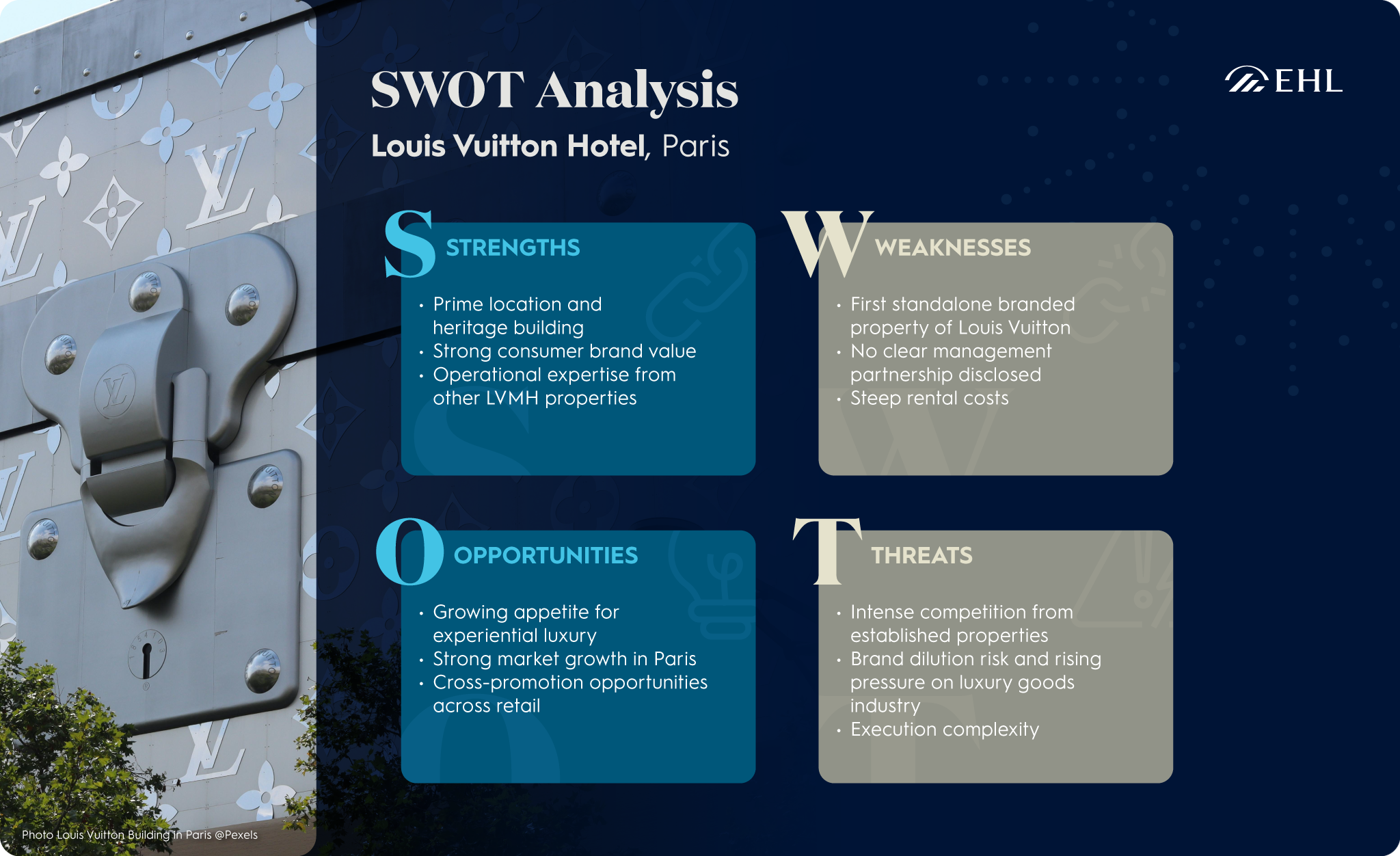
The hotel, set to open on the Champs-Élysées in Paris in 2026, is an example of a fashion house venturing into experience-based offerings. A SWOT analysis is just as useful for evaluating future ventures as existing ones.
Strengths
The Louis Vuitton brand offers unparalleled brand equity, as it is one of the world’s most valuable luxury brands. It brings built-in demand from brand loyalists, who are willing to pay substantial premiums for the maison experience.
The location could not be more prime. The heritage property was constructed in 1896 during the Belle Époque, making it architecturally significant in its own right, with views of both the Arc de Triomphe and the Eiffel Tower.
Furthermore, LVMH as a conglomerate already operates more than 50 hotel properties under different labels, including Cheval Blanc, Belmond, and Bulgari Hotels & Resorts. This gives Louis Vuitton access to proven operational know-how and supplier relationships, meaning that unlike many fashion houses, they do not have to enter hotels cold. In fact, Louis Vuitton has already dabbled in experiential luxury through restaurants in Osaka, Tokyo, and Saint-Tropez.
Weaknesses
While LVMH does have hospitality experience, this will be the first explicitly branded Louis Vuitton accommodation, which distinguishes it from LVMH’s existing Cheval Blanc properties. Building an entirely new service culture from scratch is different from extending an established hotel brand.
No clear management partnership has been disclosed, unlike Bulgari properties, which are a joint venture between LVMH and Marriott International. The execution risk is higher for the Louis Vuitton hotel without the operational consistency and distribution provided by a global operator.
Finally, according to Fashion Network, the rental costs are steep, at around €60 million in annual rent for the building. This amounts to significant fixed costs that require the hotel to sustain ultra-premium rates. For context, assuming approximately 20 keys and 70% occupancy, the property would need to generate roughly €11,700 per occupied room night just to cover rent. All this before staffing, F&B, or any other operational costs (eep!).
Opportunities
The luxury hospitality market in Paris is thriving, with rising RevPAR and strong international demand. At the same time, the general appetite for experiential luxury is growing as the demand for luxury goods softens. According to Skift, the luxury hospitality market is expected to surpass $369.36 billion by 2032 with a CAGR of 11.5%.
The hotel essentially serves as a living showroom, where Louis Vuitton can cross-promote its products through displays of the brand’s furniture line and by integrating retail into the stay experience. With the high overhead costs, I sense a strategic opportunity. If guests leave having purchased homeware or luggage, Louis Vuitton has a high-touch customer acquisition channel at its fingertips.
With its giant monogrammed façade – an homage to the brand’s roots as a trunk-maker – the construction site has already become a destination, generating social media buzz long before the property has opened.
Threats
The Louis Vuitton hotel will face intense competition from established Parisian palaces, such as Plaza Athénée, Hotel de Crillon, and the Ritz. These are all properties with decades of service refinement and loyal clientele.
According to CoStar, growing supply will add pressure to occupancy levels in the market, and price increases will be the only way to increase RevPAR. You can only push rates higher if you offer something guests cannot get elsewhere, meaning that the property can’t afford to just be another expensive albeit beautiful hotel.
It is also worth asking whether any fashion brand is strong enough to expand beyond its core business line, and how legitimate they will be in doing so. A subpar hospitality experience could tarnish Louis Vuitton’s halo in its core fashion business. To note, said halo is already not so squeaky clean, as the luxury goods industry is increasingly under pressure for stark price increases and a diminishing delivery on the value promise of quality and craftsmanship.

Strategic Takeaways of a Hotel SWOT Analysis
The hotel SWOT analysis highlights the many specificities of the Louis Vuitton hotel, both promising and precarious. We can see that it is well-positioned in terms of location and brand value and has opportunities for growth in a booming luxury travel market.
That said, Louis Vuitton cannot compete with the palaces of Paris without a distinct service offering. Given the trunk-maker heritage, why not lead with 'travel as art', which would position the stay itself as a curated journey rather than simply a monogrammed accommodation? For the Louis Vuitton hotel to have a successful opening, it needs to invest in crystallizing its service DNA to not dilute its brand through an underdelivered value proposition.
The SWOT analysis remains a tool for illuminating unique competitive advantages, opportunities for growth, and risks to mitigate for any property. It is a business analysis classic for a reason, and can be used in many situations, spanning from introducing new service offerings to a regular check-in for a long-standing property.
.jpg)