Change is the only constant in hospitality. With guest satisfaction and experience at the core of success, hospitality companies must stay ahead of the trends shaping the industry. This article explores key hospitality industry trends and offers actionable insights to help leaders make strategic investments in people, technology, and processes.
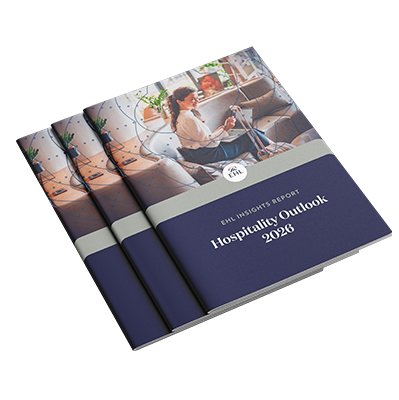
Backed by the expertise of researchers and industry professionals from EHL Hospitality Business School, as found in the Hospitality Insights Outlook Report 2026, it presents strategies to help hospitality operators adapt, gain competitive advantage, and thrive in 2026 and beyond.
Hospitality Outlook for 2026
In the US, RevPAR has remained mostly stagnant in 2025 while average daily rate (ADR) slightly increased and room occupancy declined (PWC). Europe registered growth in both RevPAR and ADR (CBRE). Global hotel performance remained mostly stagnant (The World Property Journal).
Worth noting is the performance difference between the luxury and the economy hotel segment, with the former showing significant growth and the latter a decline. Economy hotels will need to find a way to boost bookings as they face lower demand and competition from alternatives.
The hospitality industry is increasingly adopting Artificial Intelligence (AI) to deliver personalized services, reduce costs, optimize pricing, and improve operational processes and employee well-being.
The rise of AI is also transforming hospitality marketing as more and more travelers turn to Large Language Models (LLMs) like ChatGPT and Copilot to help plan their trips.
Geopolitical instability threatens tourism in multiple parts of the world. The US, especially, has suffered a decline in inbound tourism in 2025, but the FIFA World Cup taking place there might provide a boost.
Data leading the hospitality sector into 2026:
- Global Market Growth: The hospitality market is expected to grow from $5.52 trillion in 2025 to 5.82 trillion in 2026 (Hospitality Market Growth Report 2026).
- Economic Contribution: As per the WTTC, the industry’s GDP impact was expected to hit a record $11.7 trillion (10.3% of global GDP).
- According to the World Travel & Tourism Council, there are around 371 million hospitality employees worldwide at the time of writing, but with the growth expected for the sector, it would require more than 460 million extra within the next decade.
Major Hospitality Industry Trends for 2026
In this section, experts from EHL Hospitality Business School share their predictions for the key trends likely to shape the global hospitality industry this year. We’ll explore the opportunities that hospitality professionals can leverage to create a competitive edge, foster customer loyalty, and expand their market share.
AI Everywhere

Artificial Intelligence permeates the hospitality industry as travelers use LLMs as research assistants and companies deploy AI agents to improve business processes, from operations to revenue management and customer service.
As Markus Venzin, CEO of the EHL group, says, "These autonomous systems can anticipate needs, make decisions and execute complex tasks, freeing up staff to concentrate on what matters most in hospitality – the human touch."
AI for Increased Operational Efficiency and Revenue Management
The implementation of AI for revenue management can lead to a significant profit increase. AI can analyze historical data to predict future demand, making it easier to efficiently manage inventory and staff.
Similarly, it can make predictions based on historical data as well as real-time data on occupancy, competitor pricing, local and global events, and even the weather to adapt prices to expected peak and low periods through dynamic pricing strategies.
On an individual level, AI can analyze customer preferences, loyalty, and behavioral patterns to create tailored offers, including upsells and cross-sells, and allocate hotel rooms or restaurant tables.
Indirectly, AI has the power to impact hospitality businesses' bottom line by increasing operational efficiency and decreasing operational costs:
- AI lighting systems can adapt lighting to the natural light levels and room occupancy, reducing electricity waste.
- AI chatbots can answer frequently asked guest questions, reducing front desk and customer service workload so these employees can focus on more complex matters and on creating meaningful guest interactions.
- AI analysis of infrastructure and machinery can anticipate issues, while agentic AI can manage repairs and order parts autonomously, decreasing the risk of outages and expensive emergency repairs.
- AI-powered housekeeping management can dynamically assign tasks using real-time data, optimizing workflows and reducing required work hours.
- Agentic AI can analyze meal and beverage offerings, orderings, and profitability to automatically order new inventory and suggest price or menu adaptations.
According to EHL Assistant Professor Dr. Jie Yu Kerguignas, hospitality leaders "are eager to experiment with tools that empower employees."
As EHL alumnus, Vice President at Apaleon, and hospitality tech expert, Florian Montag says, the use of AI is not about “robots replacing people” but about creating a collaborative dynamic where digital assistants handle routine complexity autonomously, freeing human employees to do what they do best: provide genuine hospitality.
Using AI to Improve Employee Wellbeing
Beyond improving operations and revenue, AI can also increase employee well-being. AI-powered predictive scheduling can anticipate peak stress periods and allocate staff effectively, while AI analytics can identify patterns of overworking or absenteeism, enabling management to approach and support employees proactively.
AI can also support mental health and job satisfaction by reducing repetitive tasks and enabling more balanced workloads. “When employees feel less overwhelmed by administrative burdens, they are better able to focus on the creative, social, and service-oriented aspects of their roles,” says EHL Professor Dr. Reza Etemad-Sajadi, an expert on human-machine interaction.
AI for Personalized Guest Experiences
AI enables hospitality businesses to personalize the guest experience more than ever before, and at scale. Where analyzing large sets of guest data used to be labor-intensive, AI can efficiently identify patterns and make actionable recommendations.
As personalization has become increasingly important in recent years, the importance of this opportunity can't be understated. Personalization could transform from being a differentiator to being the industry standard, at which point those who don't offer it risk falling behind.
On the other hand, increased consumer privacy awareness and concerns might make a segment of travelers lean towards brands that don't seem to collect as much guest data (Qualtrics, Deloitte).
Marketing in the Age of Artificial Intelligence
AI brings hospitality marketers both new opportunities and new challenges. As an increasing number of travelers turn to AI for travel research and even to book trips, hospitality brands need to gain visibility in the LLMS that travelers use.
A Booking.com report released in July 2025 stated that 89% of its more than 37,000 global respondents want to use AI in future travel planning, and according to Phocuswright, "nearly 40% of U.S. travelers used gen AI tools to plan trips in 2025, an 11-point jump in just one year."
LLM optimization will need to become an increasingly big part of their marketing mix, alongside more traditional approaches such as paid advertising, social media marketing, and traditional Search Engine Optimization (SEO).
For companies with limited marketing resources, choices might need to be made, as those who move now have an opportunity to get ahead of the competition.
Luckily, AI also enables hospitality businesses to launch better-targeted and personalized marketing campaigns based on in-depth analysis of guest preferences, behavior, and other data.
On top of that, marketers can focus on strategy as AI handles data analysis, repetitive tasks, and online brand monitoring.
AI Safety Measures
With the increased opportunities that AI brings come risks. Dr Reza Etemad-Sajadi emphasizes that AI must be implemented responsibly, with safeguards for privacy, data security, and ethical considerations.
Human-Centric Leadership

With AI taking up a growing role in hospitality processes, employee retention hinging not just on remuneration but also on fulfilment and wellbeing, and the industry struggling with high turnover and ongoing staffing shortages, adopting a people-first approach is crucial.
Hospitality companies that lack staff risk a decline in service quality and often need to adjust their offerings, affecting both the guest experience and profitability.
People-first hospitality is driven by human-centric leaders who understand the importance of emotional intelligence and prioritize the needs and well-being of employees. These leaders are four times more likely to retain staff and 22 times more likely to drive high performance.
This isn't surprising, as employees who feel safe and supported are more likely to take agency, communicate openly, share ideas, and experiment.
Well-being is top of mind with younger employees and hospitality students. A study by EHL Professor of Organizational Behavior Dr Stefano Borzillo with the University of Applied Sciences HES-SO showed that Gen-Z hospitality students emphasize "the need for flatter hierarchies, transversal collaboration, and project-based work" while also expressing "concern over toxic cultures, harassment, and the issue of ‘greenwashing’, calling instead for authentic leadership and a visible commitment to diversity, inclusion, and Corporate Social Responsibility (CSR),” thus Dr Borzilo.
According to the same study, transparency and fairness are key components for retaining Gen-Z talent, as are flexible schedules, mental health support, and inter-hierarchical interactions, including a strong feedback culture.
But a people-first approach isn't just beneficial for younger workers. EHL Professor Dr Bertrand Audrin says that the business world and industry should not differentiate too strongly between the specific needs of different generations.
He states that in the end, it's the team that decides whether a leader is successful, and in that sense, human-centric leadership is important to every employee, regardless of their age or profession.
According to Frank Marrenbach, EHL IAB Member and CEO of Althoff Hotels, "leadership is what differentiates good companies from great companies."
The future hospitality leader needs to have the ability to comprehend the human mind, the willingness to dive into the complexity of people, and also the curiosity that is paired with it. And of course, good soft skills.
-
Frank Marrenbach, EHL IAB Member and CEO of Althoff Hotels
In conclusion, human-centricity is a necessary evolution for dealing with staff shortages, shifting employee values, and accelerating technological innovation. By hiring and training people who can lead with empathy, self-awareness, and authenticity, the hospitality industry can create an attractive workplace for many generations to come, improving both employee and guest satisfaction.
Regenerative Hospitality

When it comes to caring for the planet and those who inhabit it, there are still big differences between individual hospitality businesses. Some are doing the bare minimum, while others are continuously striving to reduce their ecological footprint and become a positive force in their local environment.
It's important to recognize this range as well as the (often financial) challenges that come with more sustainable practices, especially for smaller hospitality companies.
At the same time, sustainability is no longer limited to a niche segment of the industry. Environmental initiatives, recycling programs, regulations to reduce greenhouse gas emissions, and increasingly scarce resources such as water have prompted a rethink among businesses, guests, and consumers alike.
According to Booking.com, 93% of global travelers say they want to make more sustainable choices when traveling, and 69% want to leave places better than when they arrived. Travelers are generally also willing to pay more to stay at sustainable hotels.
And as the need for eco-friendly practices is increasingly acknowledged and acted on, those at the forefront are already taking it a step further.
Net zero is no longer enough; to really make an impact, companies must actively give back to their communities and ecosystems – a net positive approach that can be both purposeful and profitable.
-
Markus Venzin, CEO EHL Group
Where sustainability measures success by what is reduced or avoided – less carbon, less water, less waste – regeneration, in contrast, focuses on creating a positive impact. Instead of merely offsetting harm, regenerative hospitality aims to create new value not only for its guests but for its entire surroundings.
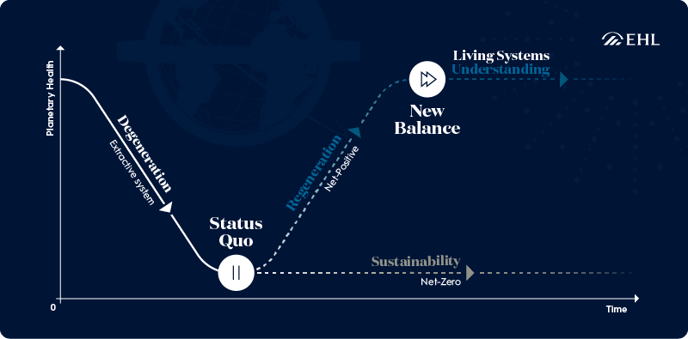
Regeneration departs from the idea that everything is connected and that changes in one system will impact others.
The hospitality industry can contribute to regeneration in different ways:
- Ecologically: by replanting mangroves, creating biodiversity, supporting local environmental groups, or collaborating with local environmental initiatives to create meaningful guest experiences.
- Socially: by offering spaces to local groups, creating a hub where locals can meet, or inviting local artists to perform.
- Economically: by training and hiring locals, or working with local vendors.
While these may seem like big investments, they also create opportunities:
- For better local relations.
- To decrease environmental and supply chain risks.
- For brand differentiation.
Regeneration in the Foodservice Industry
The foodservice industry is uniquely positioned to positively impact social and natural environments, consumer health, and the economy as it touches so many lives every day.
Hotels and restaurants can influence sourcing, design more health-conscious menus, promote social dining practices, and foster transparency and innovation in their operations. In doing so, they can help shape consumer habits, reduce food waste, and influence sourcing practices.
On top of that, they can respond to the growing demand for food that is not just satisfying but also supportive of guests' personal and the planet's well-being.
Adopting a more regenerative approach is often seen as expensive and reserved for niche, premium brands. EHL Professor and author of a recent EHL study around the topic, Dr. Carlos Martin-Rios, believes this needs to change.
He also stresses that sustainable food practices can give hospitality companies of all sizes a competitive edge by "opening new revenue streams, improving efficiency, and winning sustainability-minded customers."
At the same time, it's important to acknowledge that adopting regeneration or sustainability practices isn't always easy, especially for smaller businesses. There needs to be "a balance between immediate operational needs and long-term environmental objectives, positioning sustainability not only as a moral imperative but also as a driver of competitiveness and resilience in the evolving foodservice landscape," as Dr Martin-Ross says.
Blockchain for Quality Control and Traceability
Advancements in blockchain technology make it possible for both foodservice businesses and consumers to trace ingredients through the supply chain, back to the source. This makes it possible to check their quality and how sustainable they are, aside from contributing to food safety.
On top of that, blockchain could help with
- Food donation and redistribution,
- Safeguarding animal welfare,
- Food waste management.
It wouldn't just be beneficial for the environment either. According to Settle Mint's industry report on The State of Blockchain Transformation in Supply Chain, 86% of supply chain leaders believe that using blockchain can offer a competitive advantage.
Measuring Regeneration Efforts
More so than sustainability efforts, which can be measured according to how much they reduce or maintain something (waste, water, trees), regeneration efforts are harder to measure. Strictly defined metrics haven't yet been established.
The success of regeneration becomes visible in more biodiverse landscapes, nature restoration, cultural preservation, increased positive community engagement, and experiences that increase the well-being of both guests and hosts.

Transformative Experiences

Consumers' desire for experiences remains strong in 2026.
- Booking.com revealed that couples increasingly choose memorable experiences over material gifts.
- Bain & Altagamma reported that luxury consumers continued to prioritize experiences over possessions in 2025.
- Hilton's 2025 Trends report states that one in four travelers planned to seek out unique experiences in 2025.
Hospitality companies can capitalize on this trend in multiple ways:
- By offering their own experiences (e.g., quiz nights at a cafe)
- By partnering with local experience providers (e.g., a B&B inviting a chef to offer its guests a cooking workshop)
- By creating experiences for and with other industries. (e.g,. a fashion brand partnering with a hospitality organization to open its own cafe)
Experiences have always been an important part of the hospitality sector, and while hospitality companies have continued to develop the guest experience, we also see an increase in guest expectations.
"Immersive experiences have become so important and popular because the expectations of our guests and travelers from all over the world have become much more sophisticated in the last few years," says Christoph Hoffmann, EHL IAB Member and Founder of 25hours Hotels and Bikini Island & Mountain Hotels.
EHL Assistant Professor Dr. Valentina Clergue also notes a shift from more passive to more transformative and immersive experiences.
Guests want to learn, feel, act, be entertained, and escape their daily lives - sometimes all at once. And when it comes to hospitality, the human component plays a crucial role in this.
Ways to Create Immersive Experiences
Some techniques hospitality organizations can use to create immersive experiences include:
- Storytelling
- Gamification
- Sensory marketing
“Engaging the senses is key when creating memorable experiences. The more senses an experience stimulates, the deeper and more lasting its impact becomes, because sensory cues enrich the experience beyond the functional act itself and activate multiple senses to evoke emotion and immersion,” says Dr. Chen.
Technology can also play a role in creating an immersive experience. Just think of video mapping, interactive displays, and virtual and augmented reality.
It is not necessary to have a huge budget to turn an experience into an immersive one, emphasizes Dr. Chen. “There are many niche opportunities for all types of businesses, whether big or small, to help people reconnect to real life and real human interaction by weaving the experiential into the offer. For example, a laundromat in the Netherlands has turned its business into a place for sharing food, meeting people, and hosting parties,” she says.
Events as Drivers of Travel

Consumers aren't just looking for experiences once they've decided where they'll travel or, in the case of locals, what they feel like doing. They go as far as to travel specifically to have a certain experience.
A global American Express survey showed that 60% of respondents planned to book a trip around an entertainment or sporting event.
More specific examples include:
- Destination weddings
- Concerts at iconic venues
- Creative, well-being, and personal development retreats
The hospitality industry can target these travelers by
- Marketing themselves as the perfect space for a certain type of event
- Building relationships with event organizers who share their target audience
- Collaborating with other local businesses to create packages centered around an experience
EHL Assistant Professor Dr. Matthias Fuchs also points to a possible rise in branded luxury life events. As an example, he mentions Audemars Piguet's luxurious AP houses. "These venues in prestigious cities allow VIP customers to celebrate their birthdays, enjoying personalized and memorable experiences in a refined setting, " says Fuchs.
Whether through collaboration with other industries or by doubling down on its own strengths, the hospitality industry can continue to be a leader in immersive experiences if it cultivates creativity, embraces technological innovation, and keeps the human touch central to its service offerings

Key Hospitality Trends to Take Away
The key hospitality industry trends for 2026 are continuations of earlier shifts, turned up a few notches. AI is now everywhere, enabling huge improvements in operational efficiency, revenue management, and employee well-being, as well as profound personalization of the guest experience.
Consumers' increased usage of AI to research trips and activities means brands need to optimize for Large Language Models, or they risk falling behind competitors.
The growing presence of AI finds a counterbalance in the human touch. While the hospitality industry has always put the guest experience at the core of its services, we also need a human-centric approach to permeate hospitality organizations to battle high turnover and staff shortages.
Likewise, understanding the human desire for entertainment, education, escape, and beauty helps businesses create the transformative experiences guests are looking for.
Care stands at the core of future successful hospitality organizations. Care for guests, for workers, and for the planet. Customer expectations are increasingly green and socioeconomically sensitive, and many hospitality companies are learning that sustainable practices can drive growth when implemented sensibly. Others are taking it even further with regenerative projects that add value in the form of jobs, local community support, nature restoration, and more.
For those seeking a dynamic, rewarding career, hospitality offers the chance to shape a future of innovation, connection, and unforgettable experiences. The industry’s commitment to empowerment and growth makes it an inspiring and ever-evolving space to thrive.
This article has been based on The Hospitality Outlook 2026 Report, by EHL Insights.